 Adobe
Adobe  Sitecore
  Gradial
  PEGA
PEGA Operating in an Agentic World: What Every Business Leader Needs to Know About AI Agents
Jun 17, 2026 | 6 min read
TL;DR
An AI agent does work. A chatbot answers questions. That distinction matters right now: Gartner reports only 17% of organizations have deployed agents today, yet more than 60% expect to within two years. This article maps the five questions every business leader is actually asking and points to the right resource for each one.
Every leadership team we talk to has some version of the same problem. Someone in a recent meeting said "AI agent" and now there are competing definitions, competing priorities, and competing vendors. Everyone agrees it matters. Nobody agrees on what to do first.
That confusion is temporary. AI agents crossed from experimental technology to operational infrastructure in 2026. The gap between companies already running agents in production and those still watching demos is widening. This article gives you an honest map of the territory and a clear path into the conversation that actually matters for your business.
What does "agentic" actually mean?
An AI agent is a software system that monitors a data source or process, makes decisions based on what it finds, takes defined actions, and hands off results without a human triggering each step. It's not a chatbot. A chatbot sits in a window and waits for your question. An agent runs in the background on your behalf, within guardrails you've set, and surfaces results when something needs your attention.
The practical difference shows up fast. A chatbot can help you find information if you go get the document and ask the right question. An agent watches the source, pulls new documents automatically, identifies what changed, classifies the risk, and puts a recommended action in front of the right person before your team opened their laptops that morning.
What are the five questions every business leader is really asking?
In our experience building agentic systems for clients in life sciences, financial services, and insurance, the conversation surfaces the same five questions. Here's where each one leads.
What even is an AI agent? If you're starting from zero and want the clearest possible explanation of what agents are, how they differ from automation and chatbots, and why the timing matters right now in 2026, start with our explainer: What Are AI Agents and Why Should Your Business Care?
What's it actually doing inside real companies right now? This is the question that moves people from curious to convinced. We break down real operational examples, including a before-and-after from pharmaceutical commercial operations, and draw a clear line between what agents handle well today and where they still need human backup: AI Agents in Daily Business Operations: What's Working Right Now
What does my team need to work alongside one? The most underestimated part of any agent rollout is the human side. Fear of job loss is real and usually goes unaddressed. We cover what that conversation actually looks like, what skills matter, and how roles change without disappearing: What Your Team Actually Needs to Work With AI Agents
How do I start without blowing up what's working? This is the implementation guide. We walk through the right first question to ask, the most common mistake companies make when they move too fast, and what a realistic 90-day rollout actually looks like: How to Deploy Your First AI Agent Without Breaking Everything
Who's accountable when something goes wrong? Speed without ownership is a real risk. This piece covers governance for the CIO or risk officer who needs clarity before signing off: AI Agent Governance: Who's Accountable When Something Goes Wrong?
What separates companies getting value from those still watching demos?
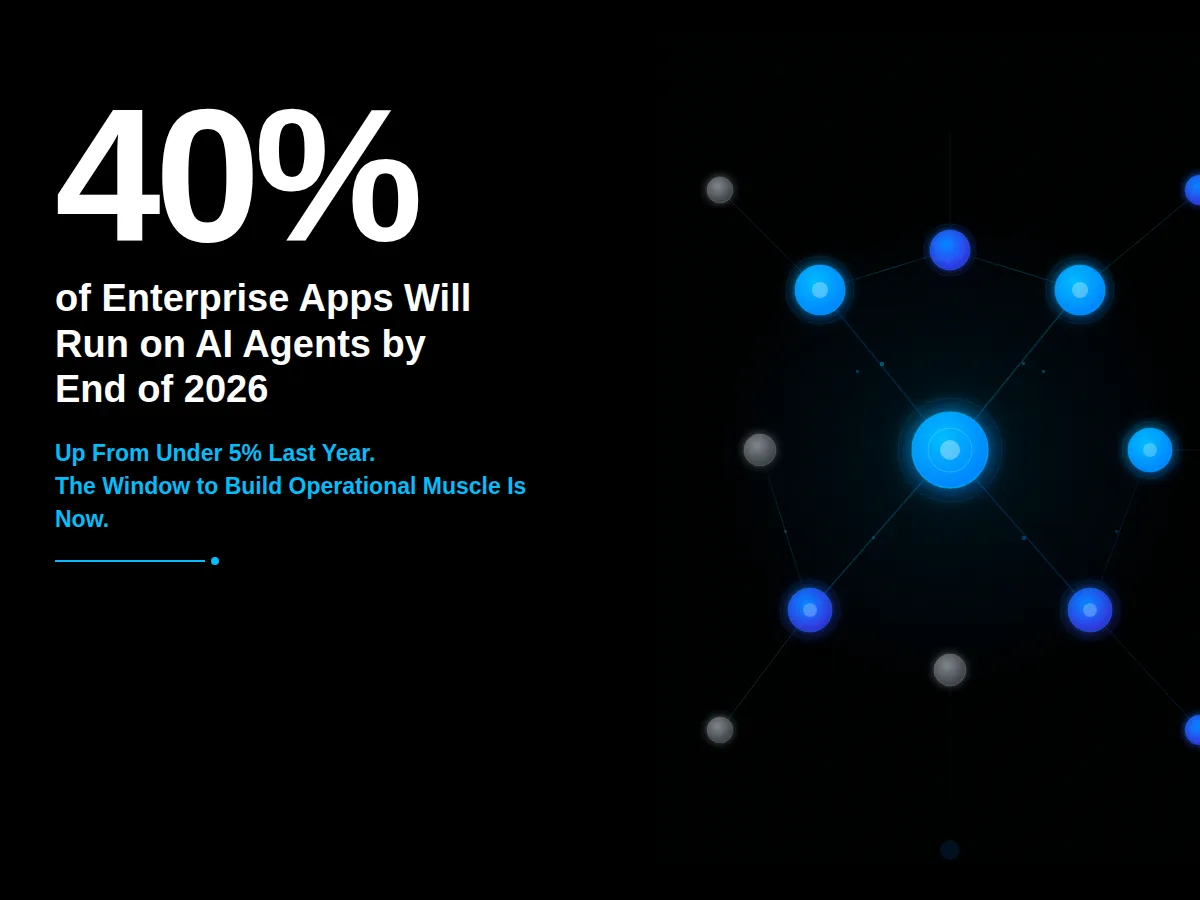
Gartner's data tells a sharp story. Forty percent of enterprise applications will embed task-specific AI agents by end of 2026, up from under 5% in 2025. Gartner also projects more than 40% of agentic AI projects will fail by 2027, most often due to poor data quality, unclear business value, or missing risk controls. McKinsey's numbers match: 62% of organizations are experimenting with agents, but fewer than 25% have scaled to production.
The companies making it work aren't more technically sophisticated. They did the process work first: identified the workflow that costs the most in time and labor, mapped the decision criteria inside it, audited the data the agent would need, and defined where a human stays in the loop. They treated the first agent as a proof of architecture, not a proof of concept.
Where do you go from here?
This series covers the full picture: what agents are, what they're doing right now, what your team needs, how to start, and how to govern it. Read in order if you're new to the topic. Jump to the spoke that answers your most pressing question if you're further along.
If you're ready to talk about where agents create the most value in your operation, connect with CI. We build, run, and manage agentic systems for enterprise clients. For background on what operational readiness actually looks like, read Building the Agentic Enterprise and No Disruption Required.
Frequently asked questions
What is an AI agent in simple terms?
An AI agent is a software system that takes action on your behalf without a human triggering each step. It monitors inputs, makes decisions based on defined criteria, executes tasks, and hands off results. The difference from a chatbot: you don't ask it questions. You give it a workflow to run.
Are AI agents only for large enterprises?
No. The cost and complexity of building agentic workflows dropped significantly between 2024 and 2026. Orchestration platforms are now production-ready for mid-market companies, and LLM token costs support real production volumes. Mid-size companies often move faster than enterprise because they have fewer legacy systems and shorter approval chains.
How long does it take to deploy an AI agent?
A realistic first deployment takes 60 to 90 days for a well-scoped single workflow: process mapping and data audit (weeks 1 to 4), agent build and shadow-mode testing (weeks 5 to 8), and supervised production (weeks 9 to 12). Companies that skip the first phase usually restart from the beginning after the agent ships with errors.
What's the biggest risk of deploying AI agents too fast?
Skipping the process definition work. Most failed agent deployments automate a poorly understood process and scale the problems. Companies with the best outcomes define every decision point and exception before the agent touches production. The build itself is usually the easiest part.
Author

Craig Taylor

Share this article


Subject Matter Expert

Craig Taylor
Practice Lead, CI Digital
Speak With Our Team
Share this article