 Adobe
Adobe  Sitecore
  Gradial
  PEGA
PEGA AI Doesn't Migrate Code. It Translates Syntax. The Hard Part Is Still Yours.
Aug 08, 2026 | 6 min read
TL;DR
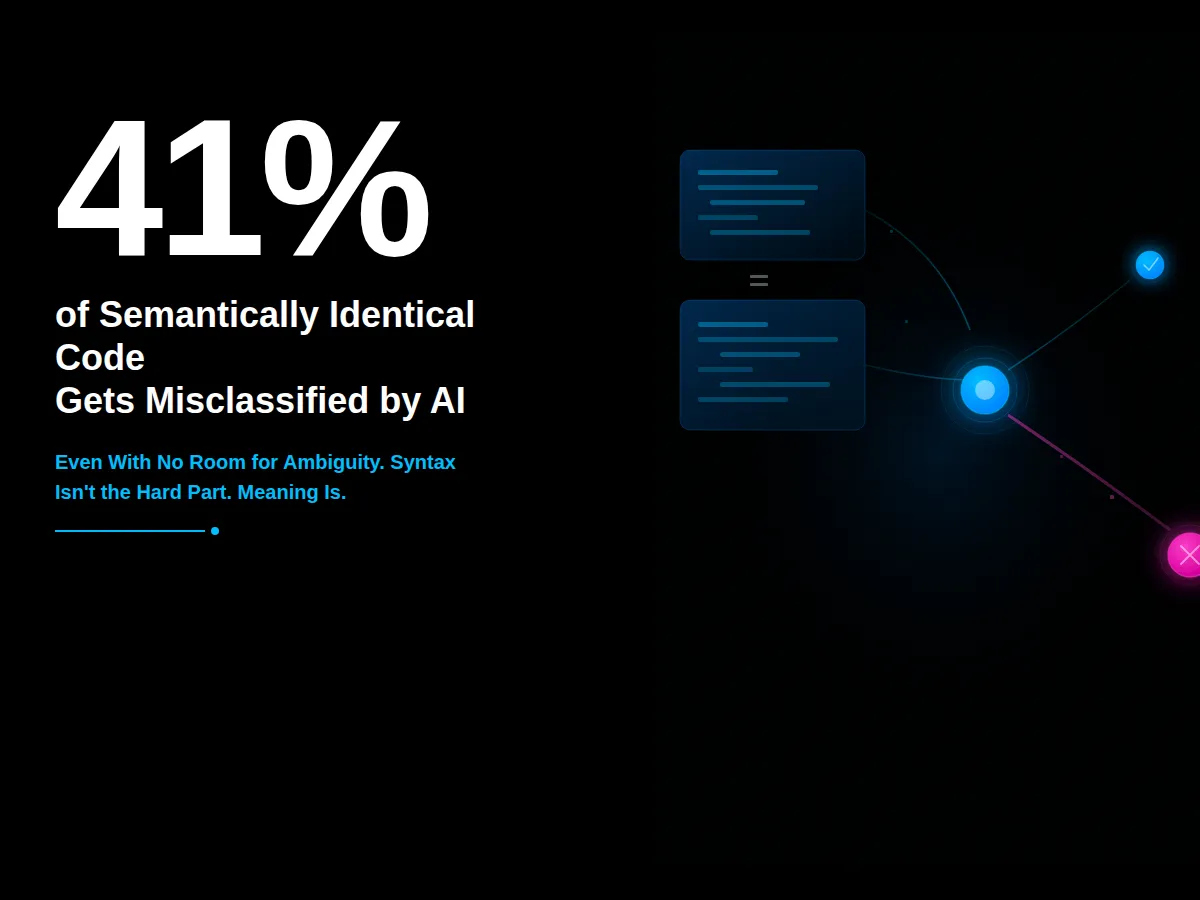
A 2026 benchmark study testing Claude, ChatGPT, Gemini, and DeepSeek found the models misclassify 41% of semantically equivalent code as non-equivalent with no context, and still get it wrong 29% of the time even with minimal context, on code a competent developer could recognize as identical in seconds. AI is genuinely good at syntax translation. It is not reliably good at understanding whether two pieces of code actually mean the same thing. Confusing those two capabilities is exactly how migrations go wrong.
The pitch sounds reasonable: point AI at your legacy codebase, and it migrates the syntax, the structure, even the logic, into a modern language or framework. Some vendors say it plainly. Most just let the ambiguity do the selling for them.
Here's the problem with that pitch. AI translates syntax fluently. Understanding whether two pieces of code actually do the same thing, which is the entire point of a migration, is a different and much harder problem. A 2026 benchmark study confirms current models still struggle with exactly that distinction, even on code far simpler than anything in a real production system.
That distinction, between translating syntax and understanding semantics, is the whole argument of this article. Get it right and AI becomes a genuinely powerful tool in a migration. Get it wrong and you ship confident-looking code that quietly does something different than what it replaced.
What AI is actually doing when it “migrates” your code
Large language models translate code the way they translate natural language: by recognizing patterns learned from enormous amounts of training data and predicting what comes next in a structurally similar context. That mechanism is genuinely powerful for mechanical transformation. Converting Python 2 syntax to Python 3, mapping a deprecated API call to its modern replacement, restructuring a function to match a new framework's conventions, all of that plays directly to what these models do well.
None of that requires the model to understand what the code accomplishes for your business. It requires recognizing “this pattern maps to that pattern” and applying the transformation consistently. That's translation. It is not comprehension, and the difference matters enormously once you're migrating something more complex than a syntax upgrade.
The benchmark that proves the gap
A 2026 study published in the International Journal on Software Tools for Technology Transfer tested seven leading language models, including Claude, ChatGPT, Gemini, and DeepSeek, on a deliberately simple task: given two versions of the same function, one with a purely syntax-preserving transformation applied, such as copy propagation or constant folding, determine whether they compute the same result.
A competent developer looks at that kind of transformation and recognizes equivalence almost instantly. The models didn't. Without any surrounding context, they misclassified 41% of genuinely equivalent code pairs as non-equivalent. Even with minimal added context, the error rate only dropped to 29%. The researchers' conclusion was direct: despite strong performance generating new code, these models struggle with the deeper reasoning required to judge whether existing code means the same thing after a transformation.
That's not a criticism of any single model. It's a finding about the current state of the entire category, tested across multiple leading systems. And it's happening on toy-scale test cases specifically designed to be simple. A real legacy system is never that simple.
Why this matters more in a 20-year-old codebase than a fresh one
Every legacy system carries decades of context that lives nowhere but in the heads of the people who built it. A workaround added for a specific client contract. A dependency introduced to fix a bug that no longer exists, but nobody removed the fix. Business logic that diverged from the documentation years ago and never got reconciled.
If a model struggles to confirm equivalence on a clean, minimal test case explicitly designed to isolate one transformation, it has no realistic chance of reliably preserving the intent buried inside a decade of accumulated business logic it was never told about. The gap the benchmark study measured on simple functions only widens as the code gets messier, which describes essentially every legacy system anyone is actually trying to modernize.
This is the same readiness problem Gartner identified when it projected that more than 70% of AI-driven mainframe exit projects in 2026 will fail from overestimating what generative AI can actually do. The benchmark study explains the mechanism behind that projection. It's not that the technology is bad. It's that teams are asking the technology to do a job, semantic verification, that the research shows it currently can't do reliably on its own. That's an important distinction for anyone budgeting a migration timeline: the failure mode isn't a bug that gets patched in the next release. It's a category of reasoning current models haven't solved yet.
What actually works: syntax to AI, semantics to your team
The practical answer isn't to avoid AI in a migration. It's to be precise about which 80% of the work you hand to it and which 20% stays with a person who actually understands the system. AI earns its place on the mechanical work: syntax translation, API mapping, boilerplate transformation, flagging structurally similar patterns across a sprawling codebase for human review.
The semantic verification, confirming that a transformed piece of code still does what the business needs it to do, has to stay with someone who can answer the question the benchmark study shows current models can't reliably answer themselves. That's not a temporary limitation waiting for the next model release. It's a structural distinction between what pattern-matching systems do well and what they don't, and treating it as anything less is how a migration quietly breaks something nobody thought to check.
For the broader argument this piece builds on, including why the discipline this requires is actually a benefit disguised as a constraint, see AI Won't Migrate Your Legacy Codebase. It Will Finally Force You to Understand It.
Frequently asked questions about AI and code migration
Can AI understand whether two pieces of code do the same thing?
Not reliably, according to current research. A 2026 benchmark study found leading models including Claude, ChatGPT, Gemini, and DeepSeek misclassified 41% of semantically equivalent code pairs as non-equivalent with no context, and still misclassified 29% even with minimal added context.
What is AI actually good at in a code migration?
Mechanical, pattern-level transformation: translating syntax between language versions, mapping deprecated APIs to modern equivalents, restructuring code to match new framework conventions, and flagging structurally similar patterns across a large codebase for human review.
Why do AI code migrations fail on legacy systems specifically?
Legacy systems carry undocumented business logic and context that AI has no access to unless a person surfaces it first. If a model struggles to verify equivalence on simple, clean test cases, it has no realistic path to reliably preserving intent buried in decades of accumulated, undocumented logic.
Does this mean teams should avoid AI in code migrations altogether?
No. It means drawing an accurate line between what AI handles well, mechanical syntax translation, and what still requires a person: confirming the transformed code actually means the same thing as the original. Teams that draw this line correctly get real value from AI.
Author

Craig Taylor

Share this article


Subject Matter Expert

Craig Taylor
Practice Lead, CI Digital
Speak With Our Team
Share this article