 Adobe
Adobe  Sitecore
  Gradial
  PEGA
PEGA AI Won't Migrate Your Legacy Codebase. It Will Finally Force You to Understand It.
Aug 05, 2026 | 5 min read
TL;DR
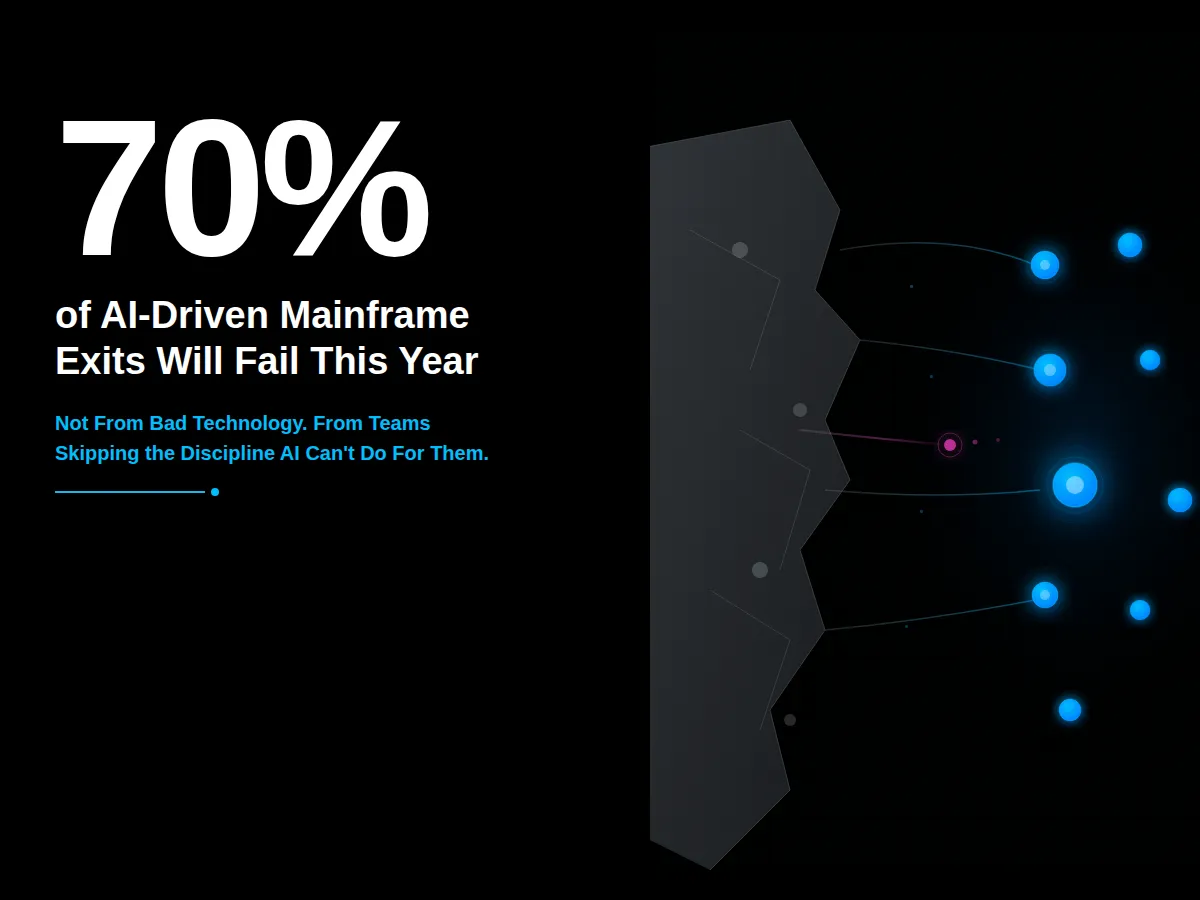
Gartner projects that more than 70% of mainframe exit projects started in 2026 will fail because teams overestimated what generative AI can actually do. AI is not an autonomous migrator. Its real value is forcing the documentation, dependency mapping, and architectural clarity that most legacy teams have been putting off for years. Companies expecting a hands-off rewrite get burned. Companies using AI as a forcing function for that discipline come out the other side with a system they actually understand.
Every legacy modernization vendor pitch this year sounds roughly the same: point AI at your old codebase, and it migrates itself. Faster, cheaper, less painful than the manual approach that used to take years. It's a compelling pitch. It's also, according to Gartner, on track to fail for most of the companies buying it.
Gartner's analysis, published in June 2026, projects that more than 70% of mainframe exit projects initiated this year will fail to deliver their intended benefits, specifically because of overestimating generative AI's ability to transform and migrate complex legacy code. Alessandro Galimberti, VP Analyst at Gartner, put the core problem plainly: there's a widening gap between the marketing promise of GenAI and its real-world ability to migrate complex systems, and vendor pressure to embed AI regardless of whether it actually helps is making that gap worse.
We think that gap is worth taking seriously, and worth explaining clearly, because the honest version of this story is actually more useful than the hype.
What AI is genuinely good at in a migration
AI earns its place in a modernization project. Gartner's own research found that 45% of software engineers already report productivity gains exceeding 10% from AI tooling. That's real, measurable value, not marketing. AI is excellent at pattern-level, mechanical work: translating syntax between language versions, mapping deprecated APIs to their modern equivalents, flagging structurally similar code across a sprawling codebase, and handling the repetitive transformation work that used to consume weeks of senior engineering time.
None of that requires AI to understand what your system does for your business. It requires AI to recognize patterns and apply transformations consistently at a scale no human team could match manually. That's a genuinely different claim than “AI migrates your legacy system,” and the distinction matters more than it sounds like it should.
What AI still can't do, and why that's the actual problem
Gartner's research also surfaced a readiness gap that explains why so many of these projects go sideways: only 12% to 16% of engineering leaders believe their current processes, workforce structure, and architecture are genuinely prepared for AI integration. That's not a technology problem. It's an organizational one, and it's exactly the part AI can't solve for you.
A legacy system's real complexity almost never lives in its syntax. It lives in the undocumented business logic, the workaround someone added for a client contract in 2014, the dependency nobody remembers the reason for. AI has no access to that context unless a person surfaces it first. Teams that skip this step and let AI run against an undocumented system get exactly what you'd expect: fast, confident-looking output that quietly breaks something nobody thought to check.
The upside nobody markets: AI as a forcing function
Here's the part of this story that doesn't make it into vendor decks. The teams getting real value from AI-assisted modernization aren't the ones who pointed AI at their codebase and walked away. They're the ones who used the migration as the excuse to finally do the documentation and dependency mapping they'd been avoiding for years, because AI-assisted work only performs well when that groundwork exists.
Put differently: the discipline required to use AI well in a migration is the same discipline a good migration needed all along. AI didn't remove that requirement. It exposed it, and made the cost of skipping it show up faster and more visibly than a slow manual migration ever would have.
That's the honest version of this story, and it's a better one than “AI does it for you.” Companies that treat AI as a forcing function for rigor come out the other side with a codebase they actually understand, not just a codebase that got rewritten by something they didn't fully audit.
Where this series goes from here
This is the first piece in a series on what AI-assisted legacy modernization actually looks like in practice. AI Doesn't Migrate Code. It Translates Syntax. The Hard Part Is Still Yours. goes deeper on the exact boundary between what AI handles well and what still requires a person. The Companies Winning at AI-Assisted Refactoring Aren't the Fastest Ones looks at real examples of disciplined, incremental modernization work. Your Developers Are Right Not to Trust AI-Generated Code covers why healthy skepticism from your engineering team is an asset, not an obstacle. The “Big Bang” AI Rewrite Is How Migrations Die makes the case against all-at-once rewrites. And If You Can't Name Who Approved an AI-Generated Change, You Don't Have a Migration Strategy closes the series with what real accountability looks like when AI is writing production code.
Frequently asked questions about AI and legacy code modernization
Can AI fully migrate a legacy codebase on its own?
No. AI handles pattern-level, mechanical transformation well, such as syntax translation and API mapping, but it doesn't understand business logic or undocumented system context. Gartner projects more than 70% of mainframe exit projects in 2026 will fail specifically from overestimating what generative AI can do unsupervised.
What's the biggest risk of an AI-assisted legacy migration?
Running AI against an undocumented system. AI produces confident, fast output regardless of whether it actually understood the underlying business logic, which means mistakes can surface far downstream, after the change already shipped.
Does AI actually improve legacy modernization outcomes?
Yes, when paired with the discipline good migrations always required. Gartner found 45% of engineers already report productivity gains exceeding 10% from AI tooling. The gains are real, but they depend on teams doing the documentation and dependency mapping AI can't do for them.
Why are so many engineering teams unprepared for AI-assisted modernization?
Gartner found only 12% to 16% of engineering leaders believe their current processes, workforce structure, and architecture are genuinely ready for AI integration. The gap is organizational, not technical, which is exactly why AI alone can't close it.
Author

Craig Taylor

Share this article


Subject Matter Expert

Craig Taylor
Practice Lead, CI Digital
Speak With Our Team
Share this article