 Adobe
 Sitecore
 Gradial
 PEGA
AI readiness assessment: what it covers and how regulated teams run one
Oct 27, 2026 | 5 min read
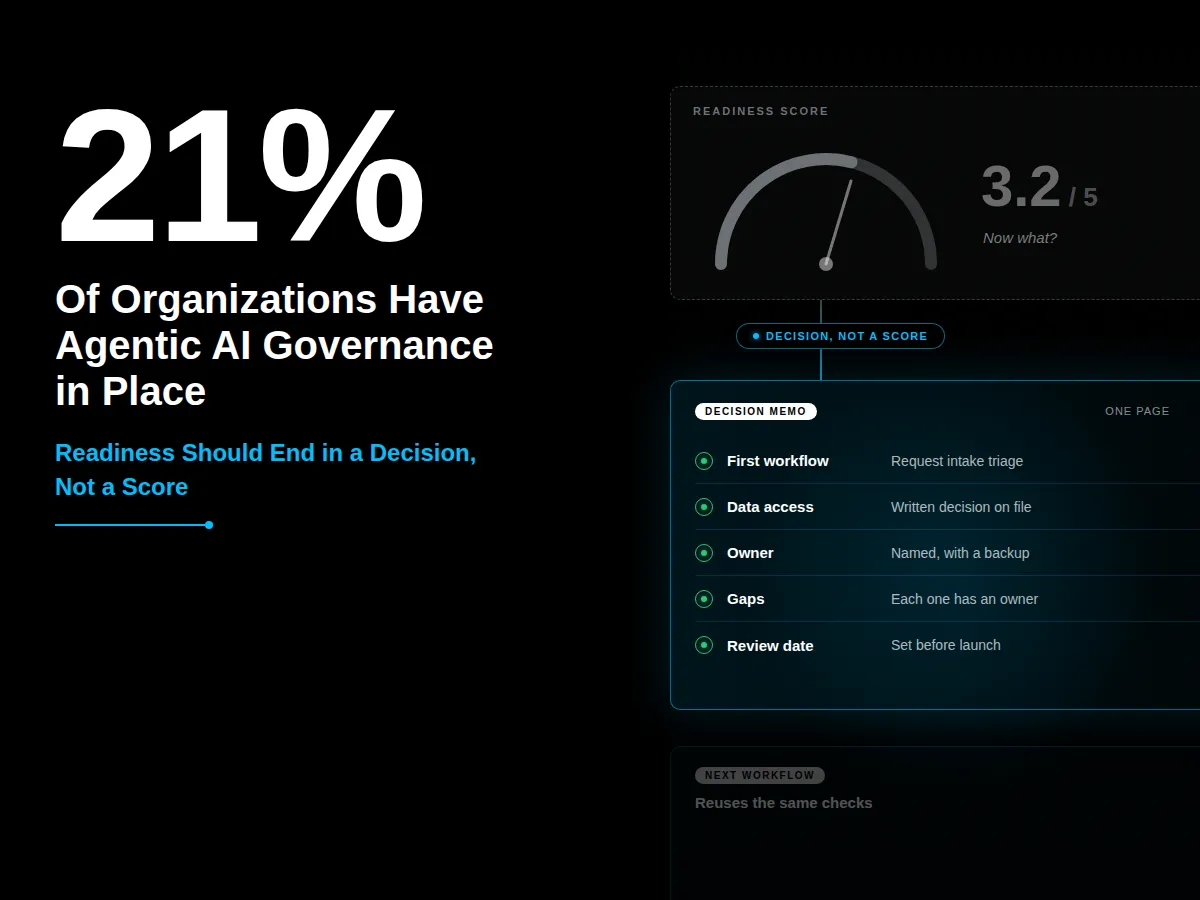
TL;DR: An AI readiness assessment checks whether your team can put AI into a live workflow. It should end in a decision, not a score. The decision names the first workflow to build and who owns each fix. Gartner found that 71% of organizations expect to deploy agentic AI within 12 months, but only 21% have agentic AI governance capabilities in place.
Picture a readiness report that says your organization scores 3.2 out of 5. The leadership team reads it and asks what to do on Monday. The report has no answer.
A readiness assessment should answer that question. It should name the first workflow to build and the gaps to close first.
This guide covers what an assessment looks at and how to run one. It sets up the readiness phase of our enterprise AI implementation roadmap.
What is an AI readiness assessment, and how is it different from a maturity score?
An AI readiness assessment is a structured review of whether a team can put AI into a live workflow. It asks one question: can we start? A maturity model asks another: how advanced are we? The first leads to a decision. The second leads to a number.
That difference matters because numbers don't build workflows. Gartner's September 2026 survey found that only 22% of organizations have successfully scaled AI across multiple business units. (Gartner, September 2026) A company-wide score doesn't show why scaling stalls. Reviewing one workflow at a time does.
If you aren't sure your team needs outside help yet, start with our post on how to tell whether your team needs AI help.
What does an AI readiness assessment cover?
A useful assessment covers five areas: ownership, data access, workflow fit, controls, and people. Each area ends with something you can write down.
Ownership: Who answers for each candidate workflow? You leave with a named owner for each workflow.
Data access: What data can the AI read, and what stays off limits? You leave with a written data access decision.
Workflow fit: Which workflows run at volume and already have a reviewer? You leave with a ranked short list.
Controls: What review points, logs, and rollback paths exist today? You leave with a gap list for controls.
People: Who reviews the AI's work, and what do they need to know? You leave with a named reviewer and a training need.
Ownership comes first. Every workflow needs one person who answers for its results. If two leaders each assume the other owns it, it has no owner.
Data access asks what the AI may read and what stays off limits. Systems matter here too. Our post on the infrastructure nobody builds before they need it covers what agents need from yours.
Workflow fit looks for work that runs at volume and already has a reviewer. That reviewer becomes the approval step. We explain why data and process clarity come first in building the agentic enterprise.
Controls checks for review points, an action log, and a rollback path. The gap here is common. Gartner found that 71% of organizations expect to deploy agentic AI within 12 months, but only 21% have agentic AI governance capabilities in place. (Gartner, October 2026) Our AI audit checklist covers what to review and when.
People asks who will review the AI's work and what they need to know. Name the reviewer now, and note the training that person needs.
What should an AI readiness assessment leave you with?
Three things: a short list of workflows in order, a gap list, and a named owner for each item. If your report has none of these, it was a quiz.
Forrester's 2026 research tells enterprises to define business outcomes and success metrics first, then pick use cases tied to them. (Forrester, April 2026) A good assessment does the same. It ties each workflow to an outcome and a measure.
Add a review date to the result. Readiness changes when the data, the rules, or the team changes.
How do you run an AI readiness assessment?
Keep the group small: one operations lead, one technology lead, and one risk or compliance owner. Run a few working sessions, not a months-long project.
First, list five to ten candidate workflows. Score each one for volume and for whether a person already reviews the work. Shortlist three.
Next, check ownership and data access for those three. Write down who owns each workflow and what data the AI may read. Drop any workflow that fails either check.
Then review controls and people for the one that remains. List the review points and rollback path it needs, and name who will review its work.
Finish with a one-page decision memo. It states the first workflow, the gaps to close, the owner of each gap, and a review date.
When should you run an AI readiness assessment?
Run one before you build the first workflow, before you shortlist partners, and again when the scope changes. Ask any partner how they would run it. Our guide to AI development services versus AI-as-a-Service lists the questions to ask.
After the first workflow ships, run a short version for each new one. The questions stay the same, and the answers come faster because the groundwork already exists.
Where should a team start?
Start with the candidate list. Write five to ten workflows on one page and score them. Name an owner for the three you shortlist. That page is the first draft of your decision memo.
If you'd like a second set of eyes on the memo, CI starts with an AI readiness assessment and works with your team from there. Talk to CI about your AI readiness assessment.
Frequently asked questions
What is an AI readiness assessment?
An AI readiness assessment is a structured review of whether a team can put AI into a live workflow. It covers ownership, data access, workflow fit, controls, and people. It ends with a ranked list of workflows, a gap list, and an owner for each gap.
How is an AI readiness assessment different from an AI maturity model?
A readiness assessment asks whether you can start, and it ends with a decision. A maturity model asks how advanced you are, and it ends with a score. A team can use the assessment first and a maturity model later to track progress.
Who should run an AI readiness assessment?
A small group should run it: an operations lead, a technology lead, and a risk or compliance owner. A partner can run it with you, but your team should own the decision memo.
How often should you reassess AI readiness?
Reassess when the data, the rules, or the team changes, and before each new workflow. Put a review date on every decision memo.
Author

Craig Taylor

Share this article


Subject Matter Expert

Craig Taylor
Practice Lead, CI Digital
Speak With Our Team
Share this article