 Adobe
 Sitecore
 Gradial
 PEGA
AI risk management for regulated enterprises: watching agents after launch
Oct 08, 2026 | 6 min read
TL;DR: AI risk management doesn't end at launch, because an agent keeps changing after the team signs off. Map your controls to the NIST AI RMF, then watch four signals in production: accuracy, drift, actions, and handoffs. Gartner predicts that 40% of enterprises will scale back or shut down autonomous agents by 2027. The cause: governance gaps found only after production incidents.
Picture an agent approved in March. The risk review took six weeks and ended with a signed document. Since then, the data feeding the agent has shifted, someone edited its prompt, and the model behind it updated. Nobody reran the review.
Many AI risk reviews end the day the agent ships. The agent doesn't stop changing. In a regulated company, that gap can turn a routine audit question into a hard conversation.
This post covers how to keep AI risk management running after launch. It builds on the controls in our enterprise AI implementation roadmap.
What is AI risk management, and why doesn't it end at launch?
AI risk management is the work of finding the risks an AI system creates and reducing them over its whole life. In a regulated company, it also means showing a regulator how you did that work.
It doesn't end at launch because the system keeps changing. Models update. Data shifts. People edit prompts and add tools. Agents also take actions, so a change in behavior can reach a customer or a record before anyone notices.
Gartner predicts that by 2027, 40% of enterprises will scale back or shut down autonomous AI agents. The cause: governance gaps found only after production incidents. (Gartner, May 2026) The way out is to find those gaps first by watching what the agent does.
Governance sets the rules, and risk management checks that the rules hold. Enterprise AI governance gives you the policies and the owners. Our post on why an AI governance framework needs visibility first explains how the two fit together.
How does the NIST AI RMF fit into AI risk management?
NIST publishes its AI Risk Management Framework as voluntary guidance. It sorts AI risk work into four functions: Govern, Map, Measure, and Manage. (NIST, 2023) NIST says it can help organizations in any sector and of any size.
Govern sets accountability and policy, and it runs under the other three. Map frames what the system does and where it runs. Measure tests and tracks the risks you mapped. Manage acts on them.
Govern: A named person answers for the agent. Control: an owner for each agent and written approval rules.
Map: You know what the agent does and what it can reach. Control: an inventory of agents, their data, and their system access.
Measure: You test the agent before launch and track it after. Control: a pre-launch risk assessment and live checks on accuracy and drift.
Manage: You can act when a signal turns bad. Control: alerts and a rollback path, with an incident log.
How do you run an AI risk assessment before launch?
List what the agent can do and what data it can reach. For each action, ask what a wrong result would cost and who would feel it first. Rate the likelihood and the impact, then match controls to the high scores.
Write the result down, because it becomes your baseline. Our guide to AI workflow automation in regulated industries shows how to turn those scores into approval rules.
What should you monitor once an agent is live?
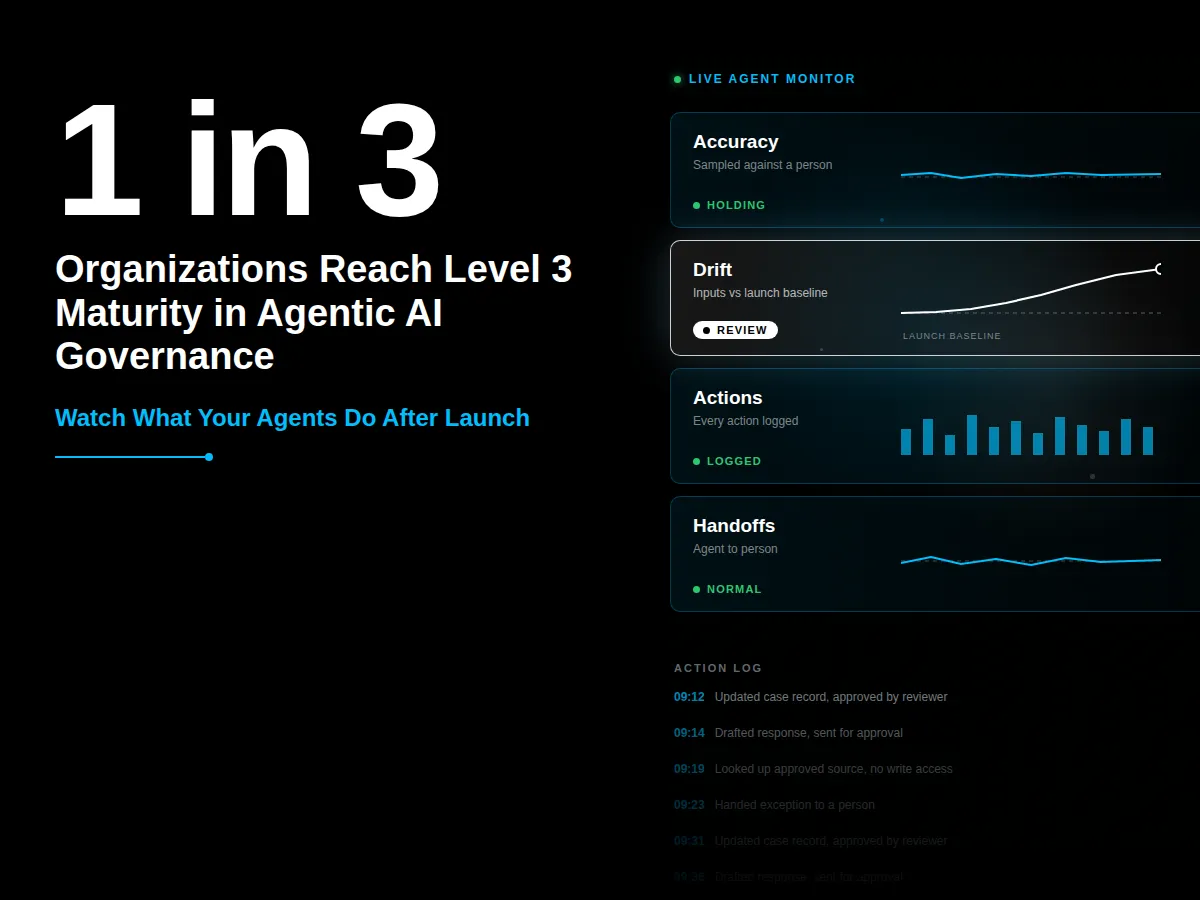
Watch four signals: accuracy, drift, actions, and handoffs. Each one answers a different question about the agent.
Accuracy asks whether the outputs still hold up. Sample outputs each week and compare them with what a person would have done. Track the miss rate over time.
Drift asks whether the world changed. Compare today's inputs and outputs with the baseline from launch. A shift in either means the agent now works in conditions you never tested.
Actions ask what the agent did. Log the system, the record, and the approver for every action. An unexpected action matters more than a small dip in accuracy, because the action has already happened.
Handoffs ask how often the agent requests help. A sudden drop can mean the agent is overconfident. A sudden rise can mean its inputs changed.
McKinsey's 2026 AI trust survey scored about 500 organizations on AI trust maturity. Only about one-third reached level three or higher in strategy, governance, and agentic AI governance. (McKinsey, March 2026) Many teams still have ground to cover.
Watching four signals across many agents is hard to do by hand. CI partners with Classie AI, a platform that supervises AI agents, to give enterprises real-time visibility and control. We describe the partnership in the CI and Classie AI announcement.
How does AI risk management support regulatory compliance?
Regulators ask versions of one question: show me what the system did and who approved it. AI risk management produces that evidence while the system runs.
Four records answer the question: the agent inventory, the risk assessment, the action log, and the review decisions. Keep them current, and an audit becomes a retrieval task instead of a reconstruction.
NIST built its framework as voluntary guidance, so check which rules apply to your industry and region. The framework still gives your teams a shared vocabulary for those records.
For more depth, see our posts on guardrails and oversight levels for agentic AI and who is accountable when an agent makes a mistake. For examples from life sciences, read which companies are getting AI governance right.
Where should a team start?
Start with an inventory. List every agent in use, what it can do, and who owns it. You can't rate risks you haven't mapped.
Then pick one agent that can reach sensitive data or take real actions. Run the risk assessment, set the four signals, name an owner, and set a review date. Repeat for the next agent.
If you'd like help with the inventory, CI will work through it with your team. Talk to CI about your AI risk map.
Frequently asked questions
What is AI risk management?
AI risk management is the work of finding the risks an AI system creates and reducing them over its whole life. In a regulated company, it also means keeping records that show a regulator what the system did and who approved it.
What is the NIST AI RMF?
NIST, the US standards agency, publishes the AI Risk Management Framework as voluntary guidance. It sorts AI risk work into four functions: Govern, Map, Measure, and Manage.
What should you monitor for AI agents in production?
Monitor four signals: accuracy, drift, actions, and handoffs. Sample outputs against human judgment. Compare inputs and outputs with the launch baseline. Log every action with its approver. Track how often the agent hands work to a person.
How often should you reassess AI risk?
Reassess whenever the model, data, prompt, tools, or permissions change. Also set a fixed schedule, such as quarterly, to catch slow drift that no single change explains.
How is AI risk management different from AI governance?
AI governance, also called artificial intelligence governance, sets the policies, roles, and approval rules. AI risk management finds and reduces risks inside those rules. Enterprise AI governance covers the whole program, and risk management checks that it works in practice.
Author

Craig Taylor

Share this article


Subject Matter Expert

Craig Taylor
Practice Lead, CI Digital
Speak With Our Team
Share this article