 Adobe
Adobe  Sitecore
  Gradial
  PEGA
PEGA AIaaS vs Traditional Managed Services: What’s Changed?
Apr 13, 2026 | 3 min
For years, traditional managed services have been the backbone of enterprise operations—providing stability, support, and scalability across IT, marketing, and engineering functions. But today, a new model is emerging: AIaaS (AI as a Service).
This isn’t just a rebrand. It’s a fundamental shift in how work gets done.
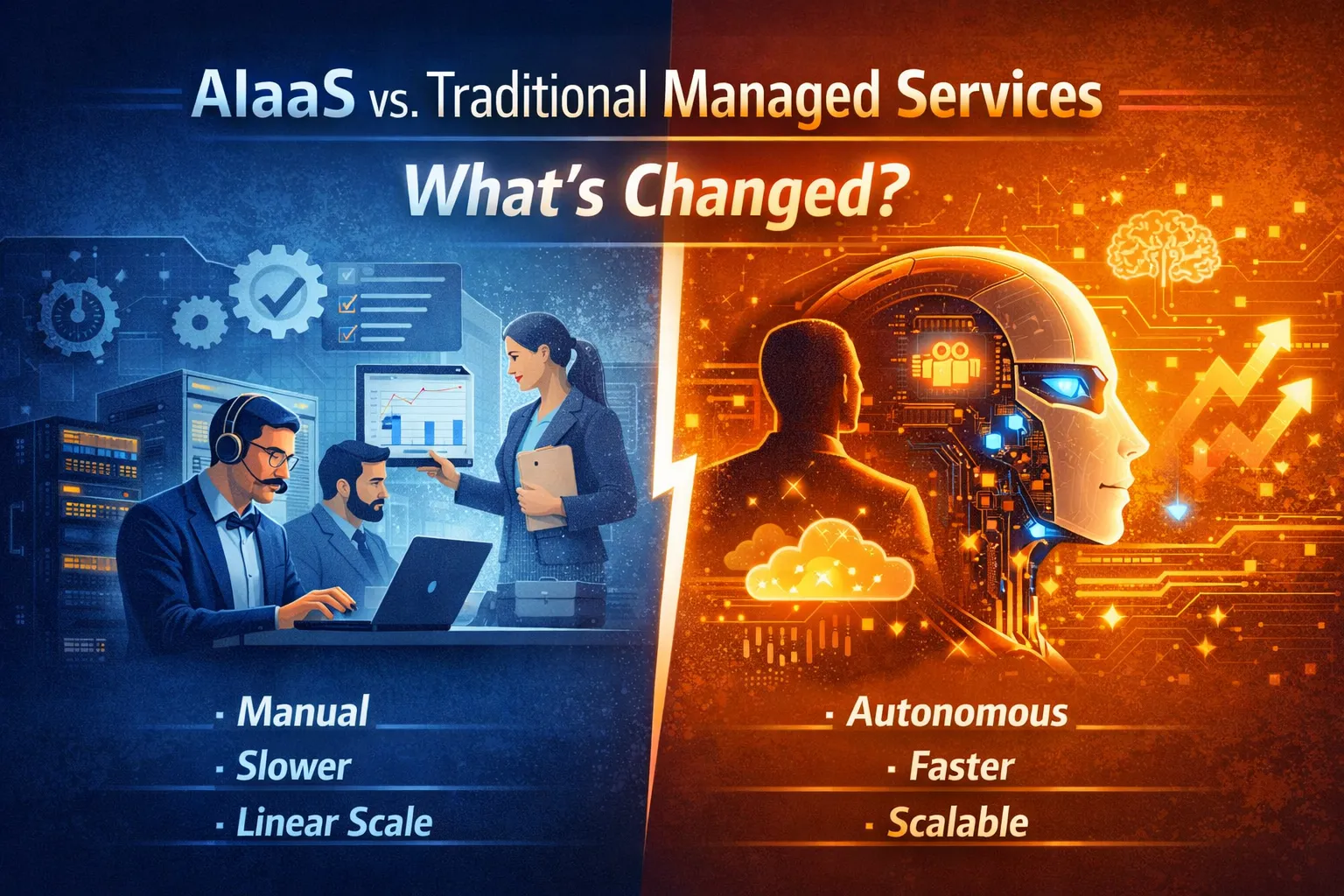
The difference comes down to three things: autonomy, speed, and scale.
The Old Model: Traditional Managed Services
Traditional managed services are built around a simple structure:
- People perform the work
- Processes guide execution
- Tools support productivity
This model works—but it has limitations:
- Linear scaling → More work requires more people
- Manual bottlenecks → Human intervention slows execution
- Reactive operations → Issues are addressed after they occur
Even with strong teams, delivery often depends on coordination, handoffs, and availability across roles.
The New Model: AIaaS (AI as a Service)
AIaaS introduces a different operating model:
- AI agents execute tasks autonomously
- Humans orchestrate, validate, and guide outcomes
- Systems continuously learn and improve over time
Instead of just supporting teams, AI becomes part of the delivery engine itself.
Across modern engineering and operations environments, AI is already:
- Accelerating development workflows
- Automating testing and quality assurance
- Enhancing backlog refinement and documentation
- Identifying risks before they impact delivery
These AI-enabled practices are increasingly embedded across the SDLC—from development to QA to product management—driving measurable improvements in speed, quality, and predictability .
What’s Changed: Autonomy, Speed, Scale
1. Autonomy: From Assistance to Execution
Traditional managed services rely on humans to perform tasks.
AIaaS shifts this dynamic:
- AI doesn’t just assist—it executes
- Repetitive tasks are handled automatically
- Decisions are increasingly data-driven and real-time
In areas like QA, AI can now:
- Detect test failures
- Cluster issues
- Suggest missing test scenarios
All without waiting for manual input .
👉 Result: Less manual effort, fewer bottlenecks, and more consistent outcomes.
2. Speed: From Delays to Continuous Delivery
In traditional models:
- Work moves in queues
- Teams wait on dependencies
- Delivery speed is limited by human throughput
AIaaS changes the equation:
- Tasks are executed instantly or in parallel
- AI accelerates development, testing, and documentation
- Teams move from sprint-based progress → continuous delivery
Even functions like backlog creation and refinement—once time-consuming—are now accelerated through AI-driven insights and automation .
👉 Result: Faster time-to-market and shorter feedback loops.
3. Scale: From Linear Growth to Exponential Output
Traditional managed services scale like this:
More demand → Hire more people → Increase cost
AIaaS scales differently:
More demand → Increase AI capacity → Minimal cost increase
Because AI handles a significant portion of execution:
- Teams can deliver more with fewer resources
- Organizations avoid constant hiring cycles
- Output grows without proportional cost increases
👉 Result: True operational leverage.
Why This Matters Now
Enterprises today aren’t just looking for support—they’re looking for:
- Predictable delivery
- Lower operational costs
- Faster innovation cycles
- Reduced reliance on large teams
AIaaS delivers on all four.
It transforms managed services from a support function into a performance engine.
AIaaS isn’t about replacing your team—it’s about amplifying it.
👉 If you’re exploring how to introduce AI into your delivery model without disrupting your existing operations, let’s connect.
We’d be happy to walk through what AIaaS could look like in your environment and where it can drive the fastest impact.
AIaaS vs Managed Services: A Simple Comparison
Capability
Traditional Managed Services
AIaaS
Execution
Human-driven
AI + human orchestration
Speed
Sequential
Parallel & continuous
Scalability
Linear (hire more)
Exponential (AI-driven)
Cost Structure
Labor-heavy
Efficiency-driven
Delivery Model
Reactive
Predictive & proactive
The Bottom Line
Traditional managed services aren’t going away—but they are evolving.
The organizations that win over the next decade will be the ones that:
- Combine human expertise with AI execution
- Shift from effort-based delivery to outcome-based delivery
- Embrace models that scale with demand—not headcount
That’s exactly what AIaaS enables.
The shift to AIaaS is already underway—and the gap between early adopters and everyone else is growing quickly.
👉 If you’re thinking about how to modernize your operations, reduce costs, or accelerate delivery, now is the time to act.
Let’s set up a quick conversation to explore how AIaaS can fit into your organization—whether that’s in IT, marketing, engineering, or across the board.
Author

Tom Boller Jr.

Sales Director - Digital
Share this article


Speak With Our Team
Share this article