 Adobe
Adobe  Sitecore
  Gradial
  PEGA
PEGA Automation or Autonomy?
Feb 16, 2026 | 3 min
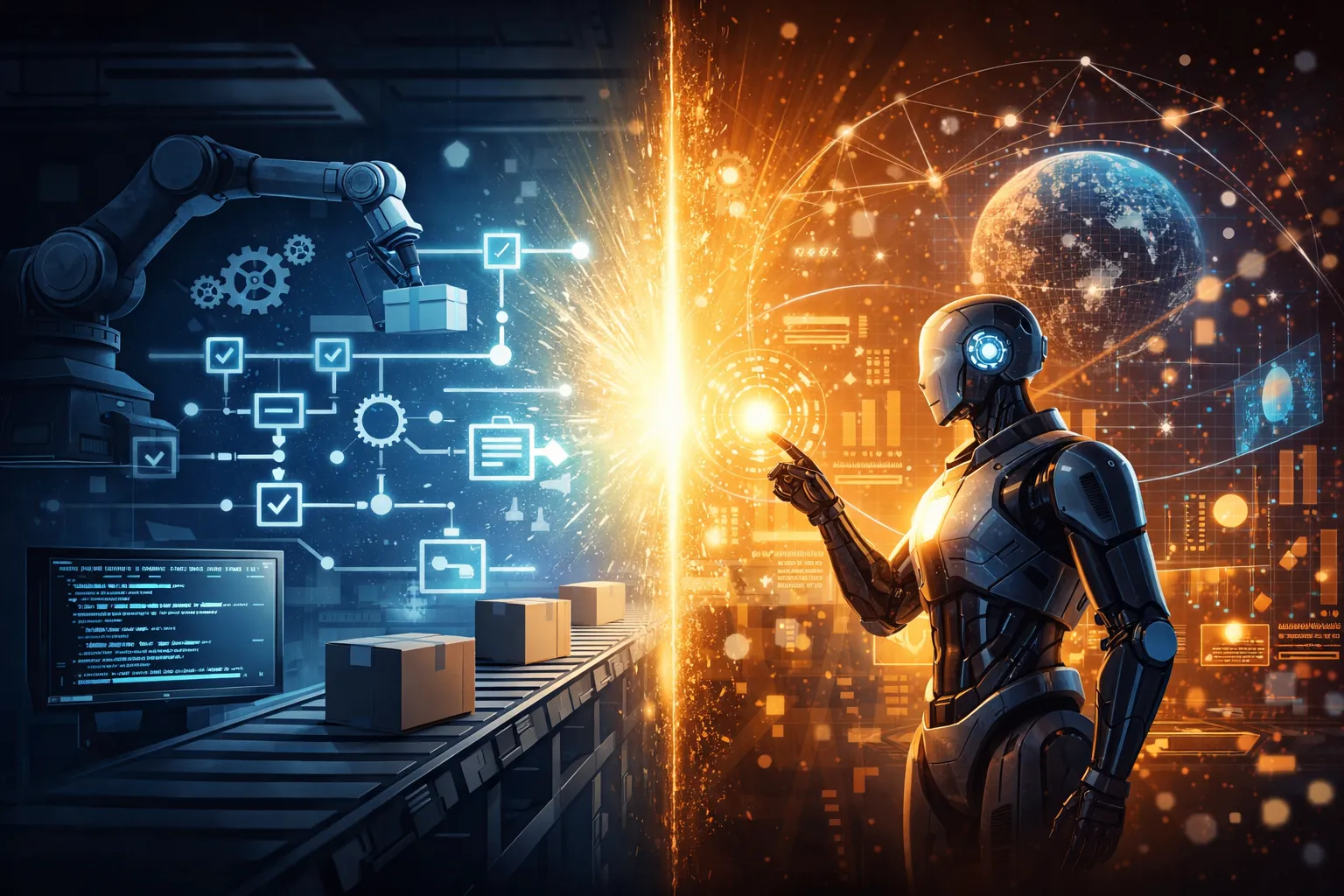
For years, businesses have relied on automation to streamline workflows, reduce manual effort, and increase efficiency. From marketing email sequences to IT ticket routing, traditional automation has been a powerful operational lever.
But today, something fundamentally different is emerging.
AI agents are not just automating tasks—they’re executing outcomes.
Understanding the difference between traditional automation and AI agents isn’t just a technical distinction. It directly impacts how your organization scales, competes, and builds operational resilience in an increasingly AI-driven world.
What Is Traditional Automation?
Traditional automation is rule-based.
It follows predefined logic:
- If X happens → Do Y
- Trigger-based workflows
- Scripted actions
- Deterministic outputs
Examples include:
- A CRM sending an email when a form is submitted
- An IT system automatically generating a ticket when an alert fires
- A marketing platform scheduling content at a predefined time
Traditional automation is powerful—but constrained. It requires:
- Clearly defined inputs
- Predictable conditions
- Manual updates when processes change
- Human intervention for exceptions
It executes exactly what it’s programmed to do—nothing more.
What Are AI Agents?
AI agents operate differently.
Rather than following static instructions, they:
- Interpret context
- Reason through decisions
- Adapt to new information
- Execute multi-step workflows autonomously
An AI agent can:
- Monitor infrastructure, detect anomalies, analyze root causes, and recommend remediation
- Review campaign performance, adjust targeting, and generate optimized variations
- Coordinate across tools, summarize insights, and initiate next-best actions
Traditional automation completes tasks.
AI agents pursue objectives.
That difference changes the operating model.
The Core Differences
1. Rule-Based vs. Goal-Oriented
Traditional automation operates on predefined rules and triggers.
AI agents operate based on goals and determine the best path to achieve them.
2. Static Workflows vs. Adaptive Decision-Making
Automation follows fixed workflows that must be manually updated when conditions change.
AI agents adjust dynamically as inputs evolve.
3. Deterministic Outputs vs. Context-Aware Responses
Automation produces the same result every time a trigger occurs.
AI agents interpret situational context and generate responses accordingly.
4. Structured Inputs Only vs. Structured + Unstructured Data
Traditional automation depends on structured data and clean parameters.
AI agents can analyze documents, logs, emails, dashboards, and conversational data.
5. Human Exception Handling vs. Autonomous Investigation
When automation breaks, humans intervene.
AI agents can investigate issues, surface patterns, and propose next-best actions before escalation.
6. Task Execution vs. Outcome Ownership
Automation completes individual steps.
AI agents are designed to drive measurable business outcomes.
Why This Difference Matters
1. Scale Without Linear Headcount Growth
AI agents allow organizations to increase execution capacity without proportionally increasing labor costs.
2. Adaptability in Dynamic Environments
Markets shift. Campaigns fluctuate. Systems evolve. AI agents can adjust in real time—traditional automation cannot.
3. Cross-Functional Execution
Agents can operate across IT, marketing, analytics, and operations—connecting systems that were previously siloed.
4. Strategic Focus for Human Teams
When agents manage repetitive, data-heavy execution, human teams can focus on strategy, creativity, and decision-making.
🚀 Ready to Move Beyond Automation?
If your organization is still relying solely on traditional automation, you may be optimizing a model built for a different era.
The opportunity now isn’t just to automate faster—it’s to execute smarter.
At Ciberspring, we help organizations design and deploy AI agents within a structured, accountable operating framework—what we call Agentic Managed Operations (MOps).
The Strategic Advantage
Traditional automation improves efficiency.
AI agents improve capability.
One reduces cost.
The other expands possibility.
The companies that recognize this shift won’t just move faster—they’ll operate differently.
Let’s Build What’s Next
AI agents are not a future concept—they’re already reshaping how modern enterprises execute.
The real question is whether your operating model is evolving with them.
The difference between automation and autonomy isn’t incremental.
It’s transformational.
Author

Tom Boller Jr.

Sales Director - Digital
Share this article


Speak With Our Team
Share this article