 Adobe
 Sitecore
 Gradial
 PEGA
How AI Can Turn Fleet Data Into Individual EV Recommendations
Oct 05, 2026 | 3 min
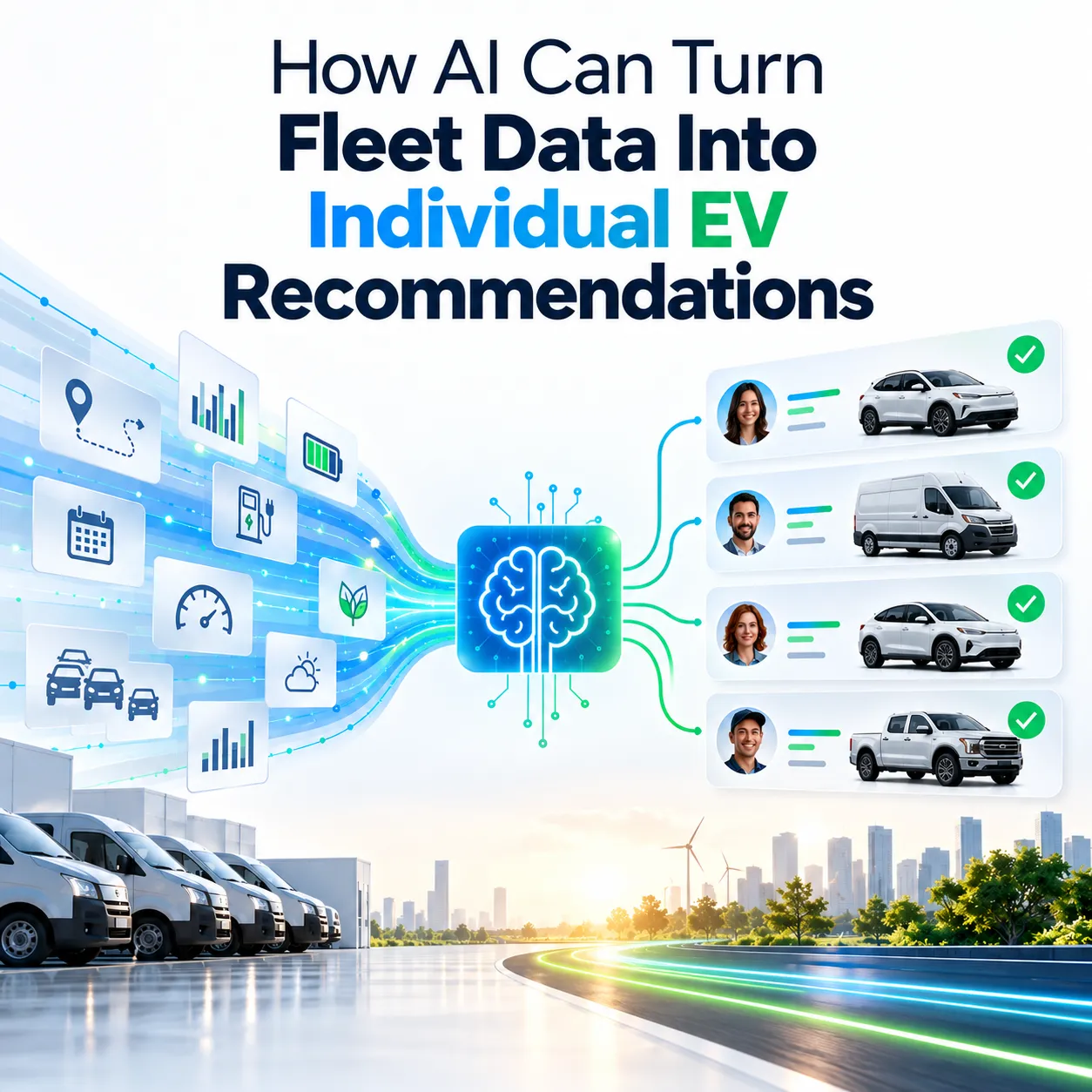
For organizations moving toward electric vehicles, one of the hardest questions isn’t whether to electrify the fleet. It’s determining which EV is the right fit for each driver, route, and use case.
Fleet operators already generate enormous amounts of useful data: daily mileage, trip patterns, idle time, route length, vehicle utilization, fuel consumption, location, charging opportunities, and more. The challenge is turning all of that information into decisions.
That’s where AI can make a measurable difference.
The Problem: Fleet Electrification Isn’t One-Size-Fits-All
Replacing a gas-powered fleet with EVs sounds straightforward until you get into the details.
A vehicle that works perfectly for an employee driving 40 miles per day may be completely impractical for someone regularly covering 200 miles. Drivers may have different access to home charging. Routes may change seasonally. Vehicle payload, climate, charging infrastructure, and total cost of ownership can all affect which EV makes the most sense.
For a fleet with hundreds or thousands of vehicles, evaluating those variables manually quickly becomes difficult.
Traditional fleet reports can tell an organization what happened. AI can help determine what it should do next.
Turning Fleet Data Into Individual Recommendations
Instead of asking an operations team to manually review spreadsheets, telematics reports, vehicle specifications, and driver profiles, an AI-powered solution can bring those data sources together.
The system could analyze factors such as:
- Average and maximum daily mileage
- Typical routes and driving patterns
- Vehicle utilization and downtime
- Home, workplace, and public charging availability
- Vehicle class and operational requirements
- EV range and charging characteristics
- Energy and fuel costs
- Maintenance requirements
- Total cost of ownership
AI can then match those requirements against available EV options and generate recommendations at the individual vehicle or driver level.
Rather than simply telling leadership that 60% of the fleet may be ready for electrification, the system could identify exactly which vehicles should be replaced, which EVs are the best candidates, and why.
From Analysis to Action
The real business value comes from eliminating the manual work between collecting data and making a decision.
Imagine a fleet manager opening a dashboard and seeing:
Vehicle 1847 → Recommended for EV replacement
The system could explain that the vehicle averages 62 miles per day, rarely exceeds 110 miles, returns to the same facility each evening, and has sufficient charging availability.
It could then recommend several compatible EVs based on range, vehicle class, acquisition cost, charging requirements, and projected operating costs.
For another driver, the recommendation might be completely different: keep the existing vehicle for now because mileage, payload, charging access, or route variability makes an EV impractical today.
That distinction matters. AI isn't simply accelerating EV adoption. It can help organizations make better EV adoption decisions.
Building the Solution With Ciberspring
This is where Ciberspring’s AI as a Service approach comes into play.
Organizations often have the data and understand the business problem but lack the time, resources, or specialized AI expertise required to turn the idea into a production-ready solution.
Ciberspring can help connect fleet, telematics, vehicle, charging, operational, and cost data and build an AI-powered decision layer around it.
That could include data integration, recommendation engines, automated workflows, dashboards, APIs, AI agents, and managed services that continuously improve the solution as new fleet data becomes available.
The goal isn't to introduce AI for the sake of AI. It is to reduce manual analysis and give fleet, operations, finance, and sustainability teams a practical tool they can actually use.
Thinking about how AI could turn your operational data into better decisions? Schedule time with Ciberspring to discuss the use case and what it would take to move from concept to a working solution.
What This Could Look Like in Practice
Consider a company operating 2,000 fleet vehicles across multiple regions.
Today, its fleet team might export telematics data, analyze mileage and utilization, compare vehicle specifications, evaluate charging availability, and manually build recommendations.
An AI-enabled workflow could automate much of that process.
As new data enters the system, it could continuously reassess the fleet, identify the strongest EV conversion candidates, recommend appropriate vehicles, flag exceptions that require human review, and calculate projected operating or ownership costs.
Business leaders gain clearer financial visibility. Operations teams spend less time analyzing spreadsheets. Fleet managers receive actionable recommendations. IT teams get a scalable solution integrated with existing systems.
And because the recommendation can include the reasoning behind it, users aren't simply receiving a black-box answer. They can understand the factors driving the recommendation and make the final decision.
AI as Part of the Operating Model
The bigger opportunity extends beyond EV recommendations.
Once an organization has the infrastructure to bring together fleet data and apply AI to it, the same foundation can support additional use cases: predictive maintenance, route optimization, charging optimization, vehicle utilization, anomaly detection, replacement planning, and automated reporting.
That is where AI starts becoming part of the operating model rather than another standalone experiment.
Ciberspring helps organizations bridge that gap—from identifying a high-value AI opportunity to designing, building, integrating, and supporting the solution in production.
Turn Fleet Data Into Decisions
Most organizations don't need more data. They need a better way to act on the data they already have.
For fleet electrification, AI can transform millions of individual data points into something much more useful: a clear recommendation about the right vehicle, for the right driver, at the right time.
And the same principle can be applied across countless operational challenges where teams are still manually connecting data to decisions.
Have a similar AI use case in mind? Contact Ciberspring to discuss how we can help turn the idea into a practical, production-ready solution.
Author

Tom Boller Jr.

Sales Director - Digital
Share this article


Speak With Our Team
Share this article