 Adobe
Adobe  Sitecore
  Gradial
  PEGA
PEGA How to get ROI from Dreamforce
Aug 31, 2026 | 6 min read
We've spent the first two pieces in this series arguing that Dreamforce is worth the ticket and worth attending in person this year specifically. Neither of those arguments matters if you show up and wing it. This is the part where we tell you exactly what to do differently so the trip actually pays for itself.
Why do keynotes get more credit than they deserve?
Because they're the easiest part of the trip to remember and the easiest to justify to a manager afterward. “I saw the keynote” sounds like a result. It isn't one. The keynote is the same experience whether you're in the room or on a livestream from your desk, which means it can't be the reason the ticket, flight, and hotel were worth the money. If a keynote is the best thing you can point to when someone asks how the trip went, the trip didn't work.
The actual ROI at any conference, Dreamforce included, comes from conversations that couldn't have happened any other way: a customer renewal conversation that needed to happen face to face, a prospect who'd been dodging your calls for two months but will grab coffee at an event, a partner relationship that moves twice as fast after a dinner instead of six more email threads.
What should you actually book before you land?
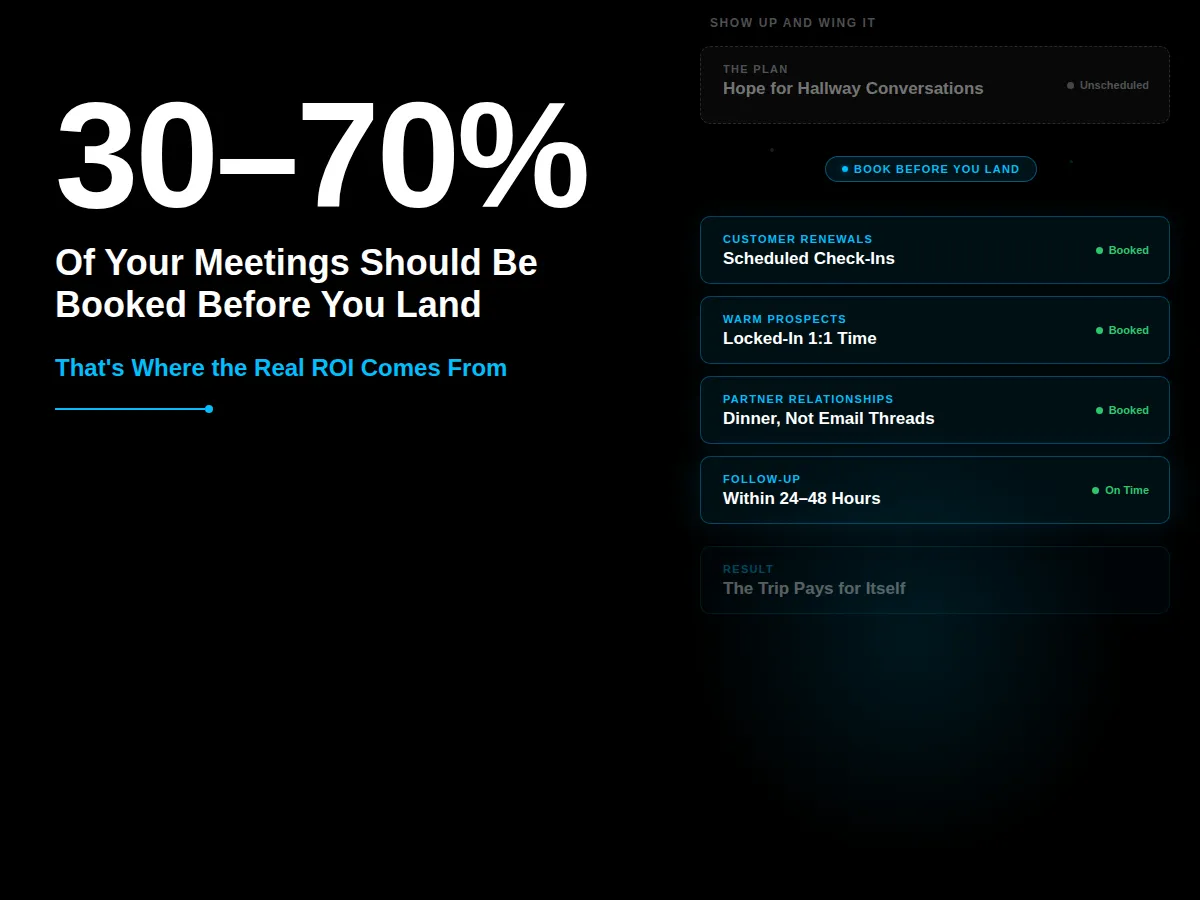
Start with your account list, not the session catalog. Pull every active customer, every warm prospect, and every partner contact who's also likely to be at Dreamforce, and reach out directly weeks in advance to lock in a specific time and place. Don't wait for the expo floor to produce the conversation. Most of the people worth talking to are getting the same pitch from a dozen other vendors that week, and the ones who book in advance are the ones who actually get the meeting.
Most B2B teams that treat conferences as a revenue channel, not a content channel, aim to walk in with somewhere between 30% and 70% of their target meetings already on the calendar before the event starts, so the floor becomes upside instead of the entire plan. (SalesHive, 2025) That's the discipline that separates a trip that pays for itself from one that produces a stack of business cards and nothing else.
How many meetings should you walk in with already scheduled?
More than feels comfortable to ask for. If you're attending Dreamforce representing a company with an existing customer base, start there: every account renewing in the next two quarters is a candidate for a scheduled check-in, and every account showing early churn signals is a candidate for an in-person conversation that a phone call won't fix. If you're prospecting, treat your target account list the way you'd treat any other outbound campaign, just compressed into a three-day window with an unusually good excuse to ask for fifteen minutes.
The data backs up the effort. Marketers report that prospects close faster after attending an event together, and roughly half of closed-won deals in a given year get tied back to event touchpoints somewhere in the sales cycle. (SalesHive, 2025) None of that comes from the keynote. It comes from the meetings someone had the discipline to book before the event started.
What do you do differently once you're on-site?
Treat the scheduled meetings as the spine of your three days, and let everything else fill in around them. Between meetings, work the demo floor with a specific question in mind rather than wandering, and use the hands-on Agentforce sessions we covered in the second piece in this series as a way to walk away with something concrete, not just a general impression of where the platform is headed.
Follow up within 24 to 48 hours of the event ending, not the following week. The data on this is blunt: the odds of converting a conversation into a next step drop off fast once that window closes, so the meetings you booked in advance need a fast, specific follow-up to actually turn into pipeline instead of a nice memory.
Our verdict
We already made the case that the ticket is worth it. The missing piece is that the ROI isn't automatic. It comes from the meetings you booked three weeks before you got on the plane, not the ones you hoped would happen once you landed. Walk in with a real list, a real set of scheduled conversations, and a plan to follow up fast, and the trip pays for itself before the keynote even starts.
CI is attending Dreamforce 2026. Book time with our team before the event, we're setting up meetings now.
Frequently asked questions
What's the best way to get ROI from attending Dreamforce?
The best way to get ROI from Dreamforce is to book 1:1 meetings with existing customers, prospects, and partners weeks in advance, rather than relying on the sessions or expo floor to generate conversations organically. The keynotes and general sessions are the least reliable source of ROI, since they don't require in-person attendance to access.
How many meetings should you schedule before attending a conference like Dreamforce?
Most B2B teams that treat conferences as a revenue channel aim to have between 30% and 70% of their target meetings scheduled before the event starts, so unscheduled floor time becomes a bonus rather than the entire plan for generating value from the trip.
Why do scheduled meetings outperform casual networking at large conferences?
Scheduled meetings guarantee time with the specific people who matter to your business, while casual networking depends on chance encounters at an event with tens of thousands of attendees. Prospects and customers who commit to a scheduled meeting in advance are also more likely to show up prepared to have a substantive conversation.
How quickly should you follow up after meetings at Dreamforce?
Follow up within 24 to 48 hours of the event ending. The likelihood of converting a conference conversation into a next step drops significantly the longer that follow-up window is left open, so meetings booked and held during the event need fast, specific follow-up to turn into real pipeline.
Author

Gabriel Gonzalez

Share this article


Subject Matter Expert

Gabriel Gonzalez
Salesforce Solution Architect
3x Salesforce Certified professional with a passion for technology and building client relationships.
Speak With Our Team
Share this article