 Adobe
Adobe  Sitecore
  Gradial
  PEGA
PEGA Is Dreamforce worth the $1,500 ticket?
Aug 12, 2026 | 6 min read
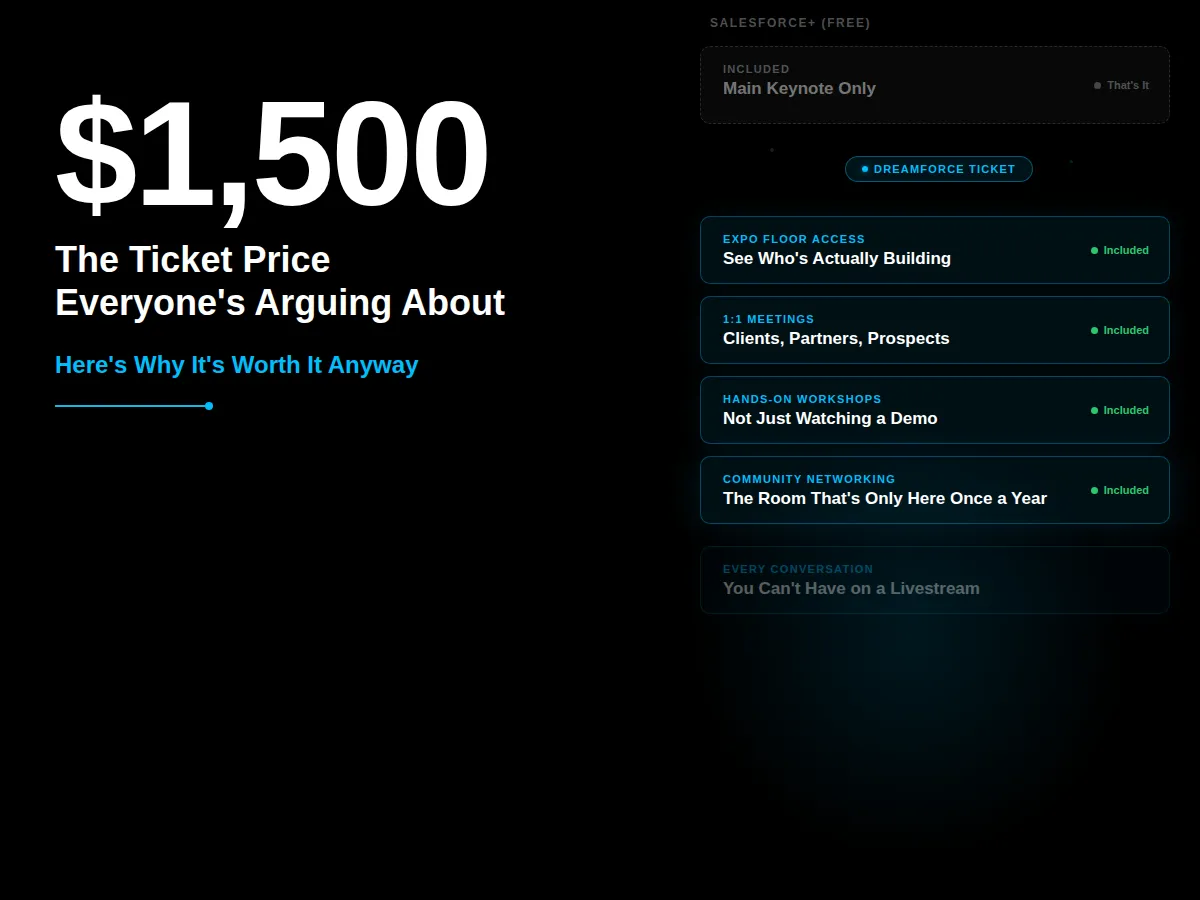
Every year, the same argument shows up in Salesforce Slack channels and LinkedIn comments the week Dreamforce pricing goes live. Someone posts the ticket cost, someone else posts a screenshot of the Salesforce+ streaming page, and the thread ends with a version of “why would anyone pay for this.” It's a fair question. It's also, in our experience, the wrong one.
We're attending Dreamforce 2026, and we bought tickets. Here's the actual math behind that decision, and why we think most people evaluating the cost are asking about the wrong line item.
What does the ticket price actually buy?
Pricing for Dreamforce 2026 has moved through several tiers as the event approaches, which is normal and exactly why the “$1,500 ticket” framing needs a footnote: as of this writing, Salesforce's own registration page has the current window priced at $1,899 through August 20, with the full Conference pass at $2,299 after that, and group passes of three or more at $999 per person. Earlier in the year, an early tier sat closer to $1,500. Whichever window you catch, the pass includes the same thing: every keynote, breakout, and theater session, hands-on workshops, roundtable discussions, community networking, the Welcome Reception, Dreamfest, and meals throughout the three days. (Salesforce, Dreamforce 2026 FAQ)
That's a lot of line items, but the one that actually justifies the price isn't on the list. It's proximity. Three days in the same city, often the same building, as tens of thousands of people who work inside the Salesforce ecosystem: customers, partners, product teams, and the account reps who normally take three email threads to schedule a call. That density doesn't show up in a session catalog. It's the entire reason the in-person pass costs anything at all.
What's the free alternative, and why isn't it the same?
Salesforce+ streams a real chunk of Dreamforce for free, including the Main Keynote and a selection of sessions, live and on demand. If your only goal is to hear the product announcements, the free stream gets you there. We're not going to pretend otherwise.
What the stream doesn't get you is the version of Dreamforce that actually moves a deal, a partnership, or a career forward. You can't ask a follow-up question in a breakout room through a browser tab. You can't end up next to the person who solved the exact integration problem you've been stuck on for two months while you're both waiting for coffee. You can't walk the expo floor and see, in about four minutes, which vendors are legitimately building on the platform versus which ones just bought a booth. The keynote is the part of Dreamforce that scales to a camera. Almost everything that actually matters about the event doesn't.
Who gets the most value from paying to attend?
Anyone whose job involves relationships inside the Salesforce ecosystem gets outsized value from being there in person: consultants and implementation partners meeting prospects and existing clients face to face, admins and architects comparing notes with peers solving the same problems, and sales or marketing teams who need face time with the accounts they've been trying to reach all year. If your work is entirely heads-down technical execution with no client-facing or partner-facing component, the calculus shifts, and the free stream might genuinely be enough.
For most attendees, though, the value isn't abstract. Dreamforce 2026's agenda leans heavily into Agentforce and what Salesforce calls the Agentic Enterprise, and that's exactly the kind of shift worth seeing demoed live, argued about in a hallway, and stress-tested with direct questions to the people building it, not watched once on a stream and forgotten by the following Monday.
What's the real math on ROI?
Run the numbers the way you'd run them for any other business trip. A $1,900 ticket plus flights and a hotel in San Francisco for three nights lands most attendees somewhere between $3,000 and $4,000 all-in. That's a real number, and it should be treated like one, not waved away.
Set against that: one new client relationship, one renewed contract that was wobbling, or one hire who would have taken months to find through a normal recruiting pipeline covers the trip multiple times over. The people who come back from Dreamforce saying it wasn't worth it are almost always the people who treated it as a conference to attend rather than a room full of specific people to talk to. The ticket price buys access to the room. What you do with that access is a separate question, and one we'll dig into in the next piece in this series.
Our verdict
Worth it. Not worth it unconditionally, and not worth it for every role, but worth it for the large majority of people who work in or around the Salesforce ecosystem and have any client-facing, partner-facing, or hiring responsibility at all. The free stream is a real option and a reasonable one for a narrow set of purely technical roles. For everyone else, the ticket price is buying proximity to a room that doesn't exist anywhere else for the other 362 days of the year.
CI is attending Dreamforce 2026. Book time with our team before the event, we're setting up meetings now.
Frequently asked questions
How much does a Dreamforce 2026 ticket cost?
Pricing has moved through several windows as the event approaches. As of this writing, Salesforce's registration page lists the current tier at $1,899 through August 20, 2026, with the full Conference pass priced at $2,299 after that. Group passes for teams of three or more are available at $999 per person. An earlier tier in the year priced closer to $1,500.
What's included in a Dreamforce Conference pass?
The Conference pass includes access to all keynotes, breakout and theater sessions, hands-on workshops, roundtable discussions, community networking events, the Welcome Reception, Dreamfest, and daily meals throughout the three-day event.
Is the free Salesforce+ stream a good substitute for attending Dreamforce in person?
It depends on what you need from the event. Salesforce+ streams the Main Keynote and select sessions for free, which covers the product announcements. It doesn't replicate the networking, hallway conversations, and expo floor access that make up most of the in-person value, particularly for consultants, partners, and sales or marketing roles with client-facing responsibilities.
Who benefits most from attending Dreamforce in person?
Consultants and implementation partners, admins and architects, and sales or marketing professionals with existing or prospective client relationships in the Salesforce ecosystem tend to see the most value from attending in person, since most of the ROI comes from face-to-face access rather than session content alone.
Author

Gabriel Gonzalez

Share this article


Subject Matter Expert

Gabriel Gonzalez
Salesforce Solution Architect
3x Salesforce Certified professional with a passion for technology and building client relationships.
Speak With Our Team
Share this article