
 Adobe
Adobe  Sitecore
  Gradial
  PEGA
PEGA What is a Provider 360 in pharma, and why your CRM isn't one
Jul 01, 2026 | 7 min read
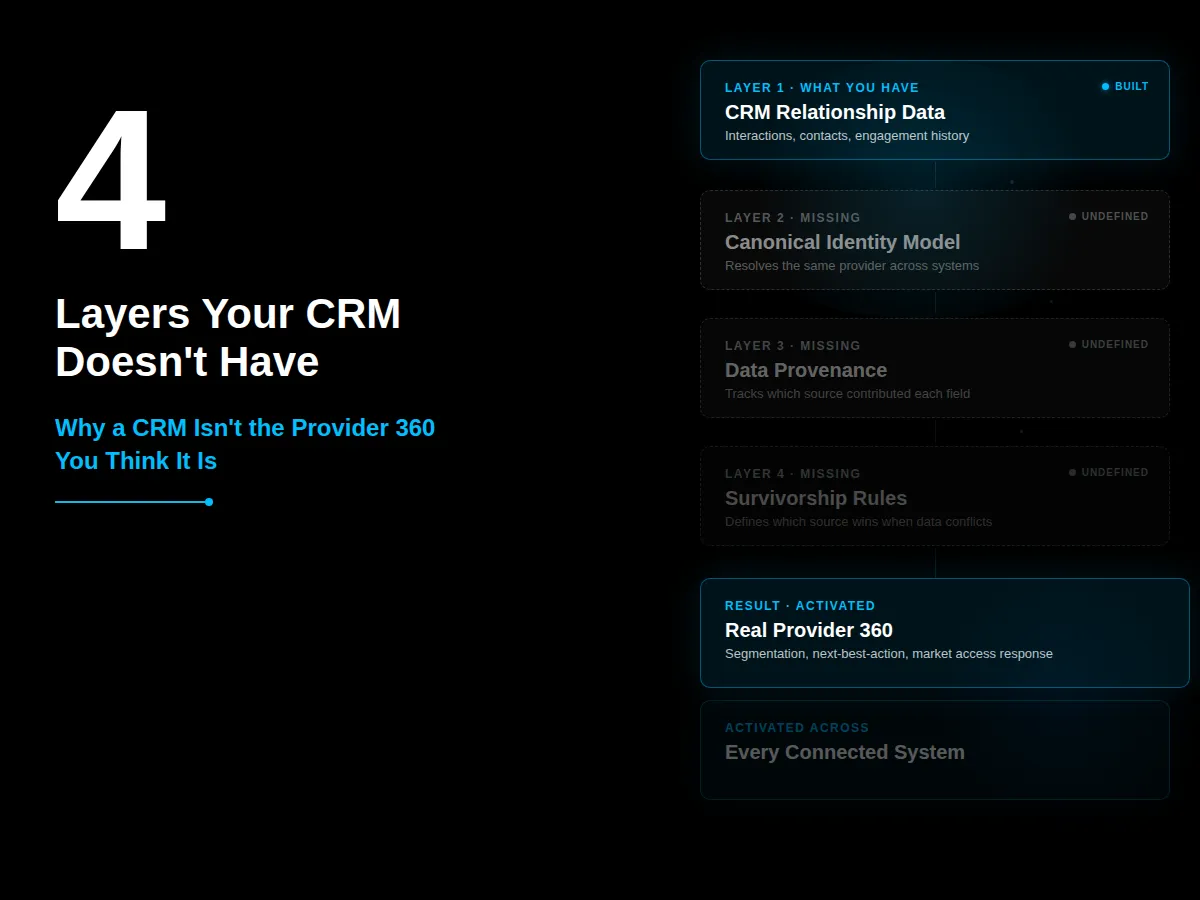
A CRM stores HCP relationship records. A Provider 360 resolves identity across every system that touches that provider, tracks where each data point came from, applies rules for which source wins when sources disagree, and activates that unified profile into segmentation and next-best-action workflows. Those are four distinct architectural layers. Most pharma organizations have built one of them and assumed the other three came with it.
A commercial operations director pulls up a provider record in the CRM. Name, specialty, address, recent interactions. Looks complete. She calls it a 360 view in the quarterly business review, and nobody in the room disagrees.
Three weeks later, a different team pulls the same provider from the claims data integration and gets a different specialty code. Medical affairs has a third version with an affiliation that changed eight months ago and never made it into the CRM. None of these systems is wrong, exactly. They're just unaware of each other. And the CRM, despite holding the most polished view, was never built to resolve which version is current.
What is a Provider 360, really?
A Provider 360 is a governed, unified view of a healthcare provider built from every system that holds data about them, with explicit rules for identity, sourcing, and trust. It answers four questions with confidence: which records across your systems refer to the same person, where each data point in that person's profile came from, which source wins when two systems disagree, and how that resolved profile gets used downstream in segmentation, engagement, and reporting.
A CRM answers none of those questions by default. It's a relationship management tool. It tracks interactions, stores contact details, and lets a field rep log a visit. That's a real function, but it's a different job than identity resolution.
Why does having a CRM make teams think they already have one?
Because the CRM is usually the most visible, most polished system in the stack. It has a clean interface. The data looks structured. Reps interact with it daily, so it feels authoritative by virtue of being the most used.
But visibility isn't the same as completeness. The CRM holds whatever data got entered into it, by whoever entered it, whenever they got around to it. It doesn't reach into the claims platform to check if a specialty code changed. It doesn't compare its own provider list against the speaker bureau's list to catch a duplicate. Choosing between CRM platforms like Salesforce and Veeva matters, but the choice of CRM doesn't solve the identity resolution problem on its own. That requires a separate architectural layer.
Forrester's research on CRM and industry cloud adoption found that 61% of global business and technology professionals wanted to increase their use of industry-specific clouds in 2024, citing customer data still locked in operational silos as a core driver. (Forrester, 2024) Pharma is no exception. The CRM doesn't break the silos. It just gives one of them a nicer interface.
What does a real Provider 360 require architecturally?
Four layers, and most organizations have built one or two of them without realizing the other two exist.
The first is a canonical identity model. The organization needs a confident, rules-based answer to whether “Dr. Jonathan Smith” in the CRM and “J. Smith MD” in the claims system are the same provider. That answer comes from NPI matching, address comparison, and specialty cross-referencing, not from someone eyeballing two records and guessing.
The second is data provenance. Every field in a provider's profile should carry a record of which system contributed it, when, and why it was chosen over a conflicting value from another source. Without this, nobody can audit a data quality issue or explain where an outdated address came from.
The third is survivorship rules. Not every source wins for every field. The NPI registry might be authoritative for license status. A third-party data provider might be more current for hospital affiliations. The CRM might be the best source for engagement preference, since that's where reps log it. Survivorship rules formalize which source wins for which field, instead of leaving the answer to whoever updated the record most recently.
The fourth is activation. A resolved, governed provider profile is only useful if it drives something: territory alignment, next-best-action recommendations, segmentation for a launch, or routing for a market access response. A Provider 360 that sits in a data warehouse and never reaches a workflow isn't activated. It's just cleaner storage.
How does this connect to the rest of your Salesforce architecture?
A Provider 360 isn't a standalone project. It's the identity layer inside the broader architecture a pharma organization needs to run AI agents, segmentation, and real-time activation reliably. CI Digital's framework for a connected pharma enterprise on Salesforce breaks that architecture into four layers: operating model, data model, integration and governance, and activation. Provider 360 lives inside the data model layer specifically, the layer where identity, provenance, and survivorship get defined.
Gartner's MDM Maturity Model places most large organizations at Level 2, Developing, on a five-level scale that runs from Initial to Optimizing. (Gartner) Level 2 means the organization recognizes master data problems exist but hasn't built the formal governance, rules, and tooling to resolve them systematically. That's where most pharma commercial operations teams sit with HCP data specifically: aware of the fragmentation, without the architecture to fix it.
Salesforce Data Cloud is built to operate at the data model layer, resolving identity and applying survivorship rules across CRM, claims, third-party enrichment, and other connected sources. It's also the foundation that makes AI use cases in pharma CRM actually reliable, since an AI agent recommending a next-best-action is only as good as the provider profile it's reasoning over.
What changes once you have a real Provider 360?
Field teams stop arguing about which version of a provider record is correct, because there's one resolved answer with a clear audit trail behind it. Segmentation for a launch pulls from a consistent provider universe instead of three slightly different exports that all claim to be current. Market access can connect a formulary change to the right providers without a manual cross-reference exercise.
The deeper change is structural. Once identity resolution, provenance, and survivorship are defined once at the architecture level, every new system that needs HCP data plugs into that resolved layer instead of importing its own copy and starting the fragmentation cycle over again. That's the difference between fixing the data and fixing the reason the data kept breaking.
CI Digital builds Provider 360 architectures on Salesforce Data Cloud and Life Sciences Cloud for pharma organizations working through exactly this gap. Talk to our Salesforce team about what a real Provider 360 would take in your environment.
Frequently asked questions
What is the difference between a CRM and a Provider 360?
A CRM stores and manages HCP relationship records: interactions, contact details, and engagement history for providers a user created or imported. A Provider 360 resolves identity across every system that holds data about a provider, tracks where each data point came from, applies rules for which source wins when sources conflict, and activates that unified profile into downstream workflows. A CRM is one input into a Provider 360, not a substitute for it.
Does Salesforce CRM include a Provider 360 out of the box?
No. Salesforce CRM, including Life Sciences Cloud, manages HCP relationships and interactions within Salesforce itself. It doesn't natively resolve identity across external systems like claims platforms, speaker bureaus, or third-party data providers. Building a true Provider 360 requires Salesforce Data Cloud or an equivalent identity resolution layer connected to those external sources, with survivorship rules and provenance tracking configured on top.
What is a canonical identity model in the context of HCP data?
A canonical identity model is the set of rules an organization uses to confidently determine that two or more records across different systems refer to the same real-world provider. It typically combines NPI matching, address comparison, specialty alignment, and affiliation cross-referencing. Without a canonical identity model, deduplication only catches exact or near-exact matches and misses providers represented differently across systems.
How long does it take to build a Provider 360 for a pharma organization?
It depends on how many source systems hold HCP data and how much governance already exists. Organizations that have already mapped which systems are authoritative for which fields can move faster, since the technical configuration of identity resolution and survivorship rules follows from decisions that are already made. Organizations starting without that governance mapping should expect the discovery and rule-definition phase to take longer than the Salesforce Data Cloud configuration itself.
Author

Jeff Sumption

Share this article


Subject Matter Expert
Jeff Sumption
Salesforce Solution Architect
Speak With Our Team
Share this article