 Adobe
Adobe  Sitecore
  Gradial
  PEGA
PEGA Your Sales Team Is Drowning in Salesforce Data. Agentic AI Could Throw Them a Rope.
May 06, 2026 | 7 min read
Your best rep closed a six-figure deal last quarter. She also spent three hours that same week copy-pasting call notes into Salesforce. Her pipeline review took another hour because half the deal stages were out of date. And she manually flagged two at-risk accounts that the CRM should have surfaced on its own.
This isn't a training problem. It's a systems problem. The CRM that was supposed to make selling easier has become the thing that gets in the way of it. The fix isn't another dashboard or a stricter data hygiene policy. It's a different kind of AI.
Why do sales reps spend more time on data entry than selling?
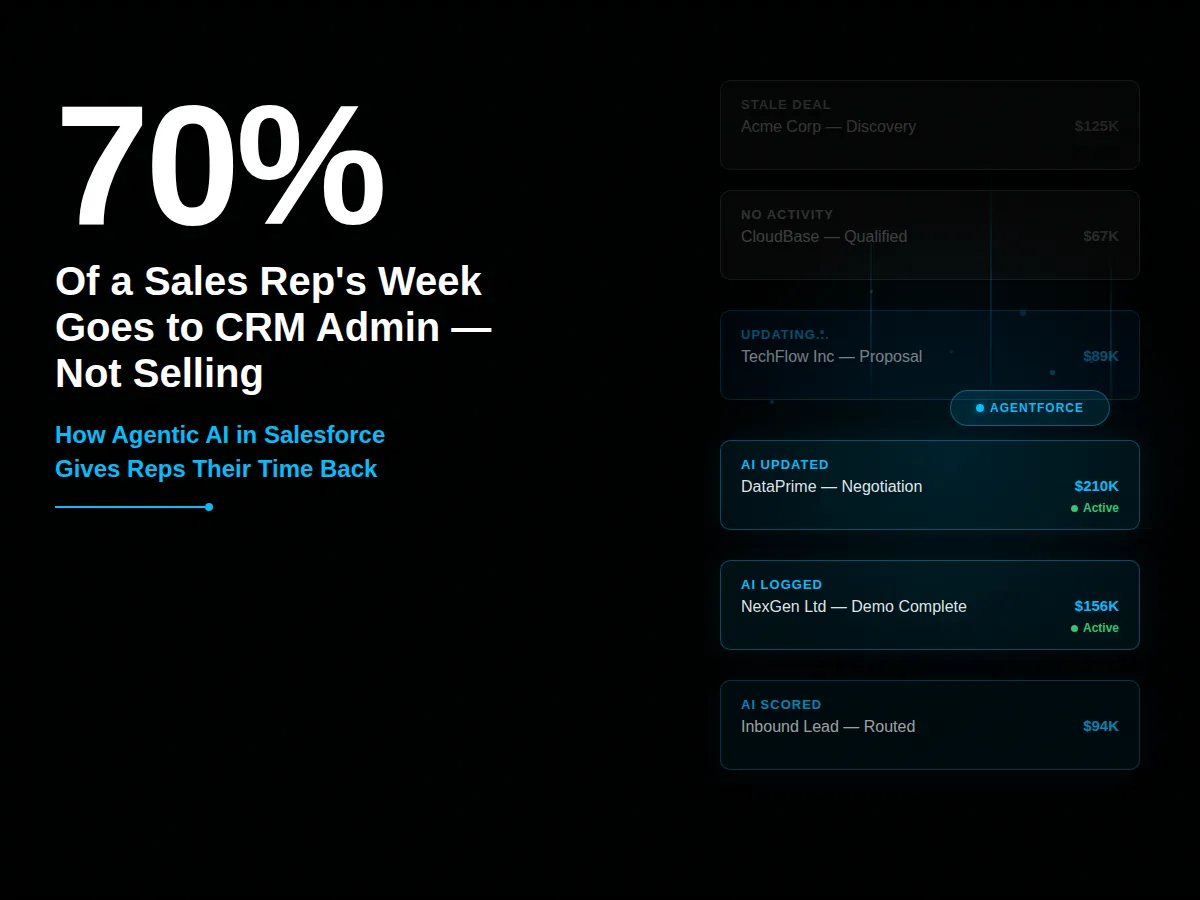
Salesforce's own State of Sales report puts the number at 70%. That's how much of a rep's week goes to non-selling tasks like CRM updates, meeting prep, deal management, and manual research. Only 30% of their time involves actual selling. (Salesforce, State of Sales 6th Edition, 2024)
The root cause isn't laziness. It's friction. Every time a rep finishes a call, they have to log the outcome, update the deal stage, note next steps, and tag the right contacts. Every week, they review pipelines, flag stale deals, and prep for forecast calls. When reps skip those steps (which they do), the data goes stale, reports break, and managers lose visibility.
The result: nobody trusts the CRM data, so everyone builds workarounds. Spreadsheets, Slack threads, sticky notes. The very system designed to give you a single source of truth becomes the thing nobody believes.
What does agentic AI actually do inside Salesforce?
Agentic AI refers to AI systems that can read context, decide on a course of action, and execute tasks on their own, within guardrails you define. Inside Salesforce, this takes the form of Agentforce, the platform's native agentic AI layer.
Instead of waiting for a rep to log a call, an Agentforce agent can pull the call transcript, extract the key details, update the deal record, and create a follow-up task. Instead of waiting for a manager to notice a deal sitting idle for three weeks, the agent flags it, adds a note about the last customer interaction, and recommends a next step.
McKinsey estimates that generative AI could add $0.8 trillion to $1.2 trillion in productivity across sales and marketing. (McKinsey, 2024) Agentic AI moves that from theoretical to practical by turning insights into action without human intervention at every step.
Here's what that looks like in practice. After a rep finishes a demo call, the agent logs the outcome, updates the deal stage from "Discovery" to "Proposal," drafts a follow-up email, and sets a reminder for the next touchpoint. That sequence used to take 15 minutes of manual work. Now it takes zero.
How is this different from the automation Salesforce already has?
Salesforce has had automation for years. Workflow rules, Process Builder, Flow. These tools follow a simple pattern: if X happens, do Y. If a lead fills out a form, assign it to a rep. If a deal closes, send a notification.
Agentic AI works differently. Instead of following a fixed script, it evaluates context and chooses from multiple possible actions. A rules-based automation can't tell the difference between a deal that stalled because the buyer went on vacation and one that stalled because the buyer ghosted. An agentic AI agent looks at email activity, call history, and engagement signals to figure out what's actually going on, then takes the right action for that situation.
The Salesforce Atlas Reasoning Engine, which powers Agentforce, retrieves relevant CRM data, builds a plan, executes each step, and evaluates the results. If something doesn't look right, it re-runs the step or escalates to a human. That's judgment, not just automation.
What does this look like for a real sales team?
Take a mid-market sales team of eight reps using Salesforce Sales Cloud. On a typical Monday morning, here's what changes with Agentforce running.
Before the team's pipeline review, the agent has already flagged six deals with no activity in the last 14 days. For each one, it pulled the last email exchange and call summary, then recommended a specific next step: re-engage with a new case study for one, loop in a technical resource for another, and mark a third as "closed-lost" because the contact left the company.
During the day, as reps take calls, the agent logs outcomes in real time. It updates deal stages based on what actually happened in the conversation, not what the rep remembers to type at 5 p.m. It scores new inbound leads and routes hot ones directly to the right rep with context already attached.
By Friday, the forecast call takes 20 minutes instead of an hour because the data is accurate. The manager doesn't have to ask "what's really going on with the Acme deal?" because the agent already surfaced the answer.
What are the risks of letting AI manage your sales data?
Fair question. Handing CRM tasks to an AI agent raises real concerns about accuracy, trust, and control. What if it updates a deal stage wrong? What if it sends a follow-up that doesn't match the rep's tone?
Salesforce addresses this through the Einstein Trust Layer. Agents respect your existing field-level security, object permissions, and sharing rules. Every action gets logged in an audit trail so you can see exactly what the agent did and why.
The bigger risk, honestly, isn't the AI making mistakes. It's deploying AI on top of bad data. If your Salesforce instance has duplicate records, inconsistent picklist values, and three different ways to categorize a deal stage, the agent will inherit that mess. Building a real agentic enterprise requires getting the data foundation right first. Only 7% of enterprises say their data is fully ready for AI agents. The other 93% have work to do before agentic AI can reach its full potential.
Where should sales leaders start?
Start small. Pick one high-volume, low-risk task where the payoff is obvious and the downside is minimal. Automated call logging works well because it's tedious, time-consuming, and easy to verify. If the agent logs a call correctly 95% of the time, your reps still save hours each week, and you can spot-check the other 5%.
From there, expand to deal-stage updates and pipeline hygiene. These are the tasks where stale data causes the most damage to forecasting and pipeline reviews. Once your team trusts the agent's output in these areas, you can move into lead scoring and next-best-action recommendations.
The data supports moving quickly. Salesforce reports that 83% of sales teams using AI saw revenue growth in the past year, compared with 66% of teams without AI. (Salesforce, State of Sales 6th Edition, 2024) That gap will only widen as agentic AI matures.
If you're running Salesforce and your reps still spend their weeks feeding the CRM instead of closing deals, the tools to fix that exist today. See what's already possible with AI inside Salesforce CRM.
CI Digital helps teams plan, implement, and scale Agentforce and Salesforce AI across sales, marketing, and service workflows. Talk to our Salesforce team about where to start.
Frequently asked questions
What is agentic AI in Salesforce?
Agentic AI in Salesforce refers to Agentforce, a platform that deploys AI agents capable of reading CRM data, deciding on next steps, and executing actions on their own within guardrails you set. Unlike traditional automation that follows fixed rules, agentic AI evaluates context and takes multi-step actions like logging calls, updating deals, and routing leads.
Can Agentforce replace my sales ops team?
No. Agentforce handles repetitive, high-volume tasks like data entry, pipeline hygiene, and lead scoring. Your sales ops team still owns strategy, process design, and exception handling. Think of it as giving sales ops a workforce that handles the operational load so they can focus on higher-value work.
How long does it take to set up Agentforce for a sales team?
A first use case like automated call logging or deal-stage updates can go live in weeks, not months. Salesforce ships pre-built agent templates for common sales workflows that you customize rather than build from scratch. Broader rollouts that cover lead qualification, forecasting, and cross-team workflows take longer and benefit from a phased approach.
Does agentic AI work with Salesforce data that's messy or incomplete?
It works, but not well. Agents inherit whatever data quality exists in your org. Duplicate records, inconsistent fields, and stale entries produce unreliable agent output. Most teams that succeed with Agentforce invest in data cleanup and process standardization before or alongside their AI rollout.
Author

Jeff Sumption

Share this article


Subject Matter Expert
Jeff Sumption
Salesforce Solution Architect
Speak With Our Team
Share this article