 Adobe
Adobe  Sitecore
  Gradial
  PEGA
PEGA Smarter Operations, Faster Outcomes: The AIaaS Advantage
May 19, 2026 | 3 min
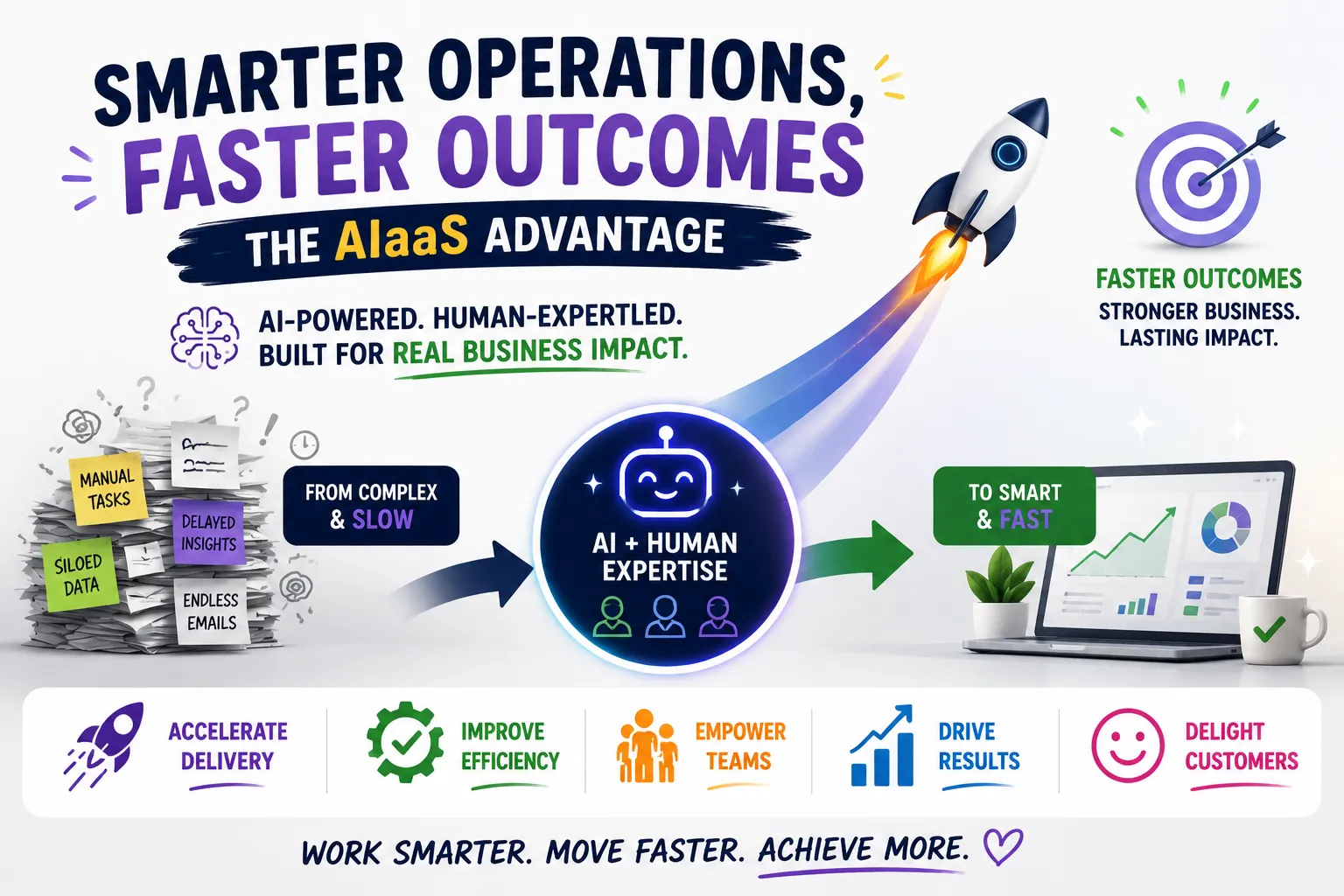
For years, enterprise technology investments have revolved around tools. Companies bought platforms, implemented software, integrated systems, and trained teams—all with the expectation that the technology itself would create transformation. But in today’s business environment, organizations are realizing something important: tools alone do not create outcomes.
Execution does.
That’s why AI as a Service (AIaaS) is rapidly emerging as one of the most effective operational models in modern business. Instead of simply providing software or automation capabilities, AIaaS focuses on delivering measurable business outcomes—faster resolution times, lower operational overhead, increased productivity, better customer experiences, and scalable operational efficiency.
The conversation is no longer:
“What tools are we buying?”
It’s now:
“What outcomes are we achieving?”
The Shift from Software Ownership to Operational Impact
Traditional enterprise technology models often place the burden of success on the customer. Businesses purchase software licenses, hire consultants, assemble implementation teams, and internally manage adoption and optimization efforts.
This approach creates several common problems:
- Long implementation timelines
- Underutilized software investments
- Operational bottlenecks
- High staffing costs
- Slow ROI realization
- Fragmented workflows across departments
AIaaS changes this dynamic entirely.
Rather than delivering a platform and expecting customers to figure out the rest, AIaaS combines:
- AI-powered automation
- Operational workflows
- Human oversight
- Continuous optimization
- Managed execution
The result is a service model focused on outcomes instead of technology ownership.
Why AIaaS Is Winning
1. Businesses Care About Results, Not Features
Executives are increasingly measured on efficiency, speed, customer satisfaction, and profitability—not on how many software platforms they own.
AIaaS aligns directly with those priorities.
Organizations adopting AIaaS are seeing improvements such as:
- Faster ticket resolution
- Reduced manual workloads
- Accelerated software delivery cycles
- Improved service consistency
- Increased operational scalability
- Lower support and maintenance costs
The value becomes tangible very quickly because the focus is operational execution, not just software enablement.
AIaaS Creates Operational Acceleration
One of the biggest reasons AIaaS is outperforming traditional managed services is speed.
Traditional delivery models often depend heavily on manual coordination between teams, repetitive tasks, documentation overhead, and resource limitations. AI-enabled operations dramatically reduce those inefficiencies.
Modern AIaaS environments can:
- Automatically triage and route requests
- Generate documentation and summaries
- Assist with engineering workflows
- Accelerate testing and QA
- Improve backlog refinement
- Surface operational risks proactively
- Enhance collaboration across globally distributed teams
We’re already seeing this transformation across Agile delivery, engineering, QA automation, and product operations, where AI-assisted workflows improve delivery predictability, reduce cycle time, and strengthen overall operational quality.
The organizations embracing AIaaS are not replacing people—they are enabling teams to operate at a significantly higher level of efficiency and effectiveness.
Ready to Explore What AIaaS Could Look Like in Your Organization?
Whether you're trying to modernize IT operations, accelerate engineering delivery, improve customer support, or reduce operational overhead, AIaaS can help bridge the gap between technology investments and measurable business outcomes.
2. AIaaS Reduces Operational Friction
Most enterprise inefficiencies are not caused by lack of software—they’re caused by friction between systems, teams, and processes.
AIaaS addresses that friction directly.
Instead of requiring employees to constantly navigate disconnected workflows, AI systems can:
- Coordinate tasks automatically
- Surface the right information at the right time
- Assist with decision-making
- Eliminate repetitive administrative work
- Improve handoffs between teams and time zones
This becomes especially valuable for global organizations managing distributed delivery models across regions like the USA, Ireland, and India, where maintaining alignment and delivery continuity is critical.
The result is smoother execution with fewer delays and less operational drag.
3. AIaaS Is More Scalable Than Traditional Staffing Models
Traditional managed services often scale linearly:
- More work = more people
- More complexity = more overhead
- More growth = more management layers
AIaaS breaks that equation.
Because AI systems can automate repetitive operational tasks, organizations can scale output without proportionally scaling headcount.
This creates:
- Greater operational leverage
- Improved margins
- Faster responsiveness
- Increased agility during growth periods
Companies are realizing they no longer need to choose between quality and scale. AIaaS enables both simultaneously.
4. Continuous Optimization Becomes Built-In
One of the biggest hidden advantages of AIaaS is continuous improvement.
Unlike static software implementations, AI-enabled operations evolve over time:
- Models improve
- Workflows optimize
- Automation expands
- Insights become smarter
- Operational data becomes more actionable
This creates a compounding effect where the system becomes increasingly valuable as adoption grows.
Organizations that embrace AIaaS early are building operational advantages that become harder for competitors to replicate over time.
The Future Is Outcome-Driven Operations
The companies leading the next decade of digital transformation will not simply be the ones with the most tools.
They will be the organizations that:
- Execute faster
- Operate leaner
- Scale smarter
- Adapt quicker
- Deliver consistently better experiences
AIaaS represents a major shift toward that future.
It’s not about replacing people.
It’s not about chasing hype.
It’s about creating operational systems that produce measurable business outcomes with greater speed, intelligence, and efficiency.
And that’s exactly why AIaaS is winning.
Let’s Talk About What AIaaS Could Do for Your Business
If your organization is exploring ways to improve operational efficiency, accelerate delivery, reduce bottlenecks, or modernize support and engineering workflows, AIaaS may be the next strategic step.
Author

Tom Boller Jr.

Sales Director - Digital
Share this article


Speak With Our Team
Share this article