
 Adobe
 Sitecore
 Gradial
 PEGA
The AI Advantage: What Modern Engineering Teams Need to Stay Competitive
Nov 09, 2026 | 3 min
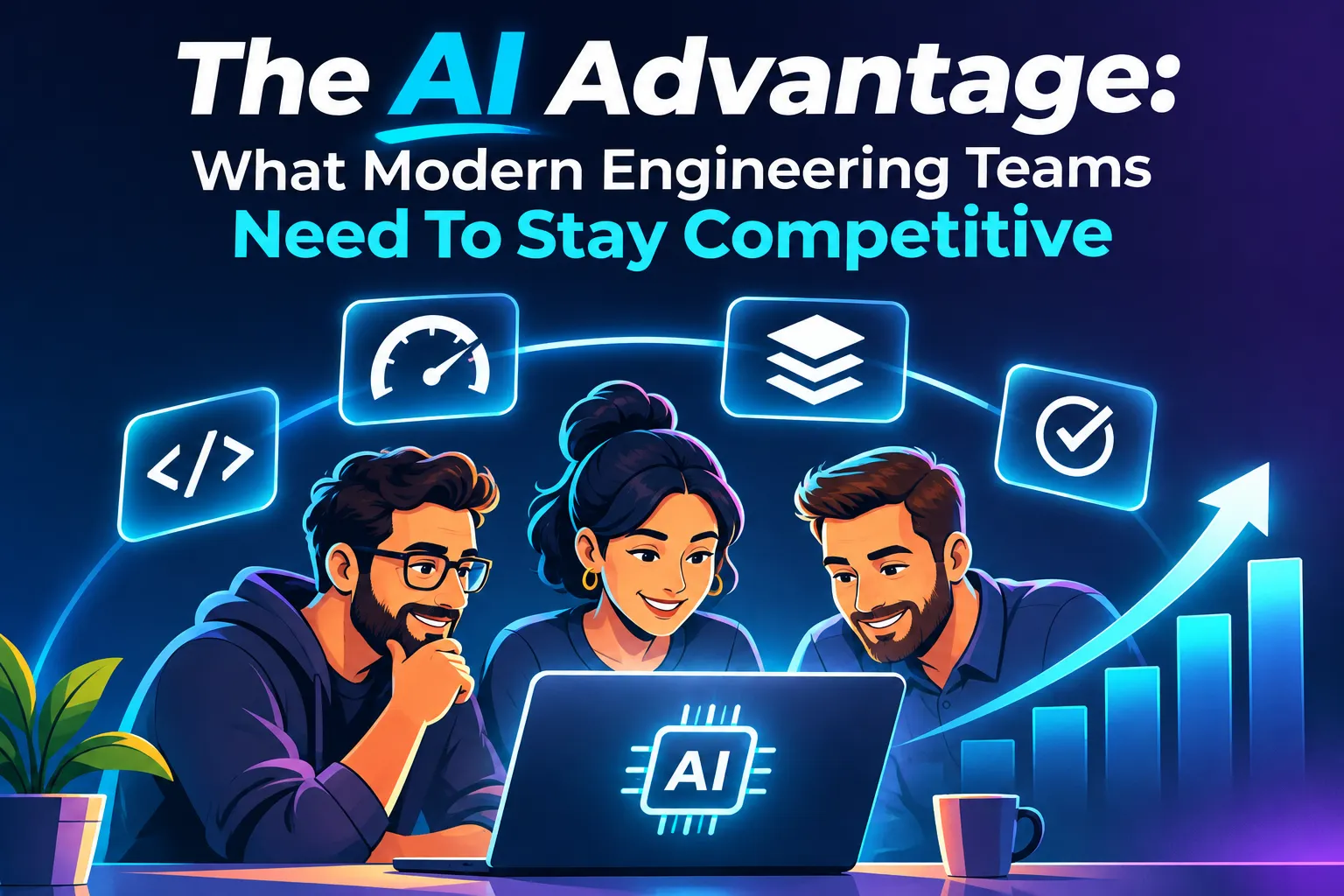
Engineering teams are under more pressure than ever.
Businesses want faster releases, better products, fewer bugs, and more innovation. At the same time, engineering leaders are being asked to control costs, manage growing backlogs, and get more out of their existing resources.
That's a tough balance.
AI is creating new opportunities to address these challenges, but simply giving developers access to AI tools isn't enough.
The real competitive advantage comes from knowing how to incorporate AI into everyday engineering workflows to improve productivity, quality, and execution.
For organizations looking to stay competitive, that shift is becoming increasingly important.
The Challenge: More Work, Same Resources
Most engineering leaders are familiar with the situation.
The development backlog keeps growing. Business stakeholders want new features delivered faster. QA teams are stretched thin, and developers are constantly balancing new initiatives with maintenance and troubleshooting.
The traditional response has been to add more resources.
Need to accelerate development? Hire another engineer. Need better test coverage? Add QA support. Need to improve delivery? Expand the team.
While additional resources are sometimes necessary, increasing headcount isn't always the most efficient solution.
A significant amount of engineering time is spent on repetitive tasks such as writing documentation, creating test cases, reviewing code, troubleshooting errors, and maintaining existing applications.
These activities are important, but many can now be supported by AI.
The opportunity isn't necessarily to make teams bigger. It's to help existing teams accomplish more.
How AI Is Changing Engineering Workflows
AI is becoming a practical part of modern software development.
Rather than replacing experienced engineers, AI can help them complete routine activities faster and focus more attention on complex technical challenges.
Here are a few areas where it can make a difference.
Faster Development
AI-assisted coding tools can help developers generate initial code, understand unfamiliar applications, support refactoring, and troubleshoot issues.
Instead of spending hours building repetitive components, engineers can use AI to accelerate the initial work and focus on architecture, security, and business requirements.
Smarter Testing and Quality Assurance
QA teams can use AI to help generate test scenarios, identify potential coverage gaps, analyze failures, and support test automation.
This can reduce repetitive testing activities while helping teams identify issues earlier in the development process.
Less Manual Documentation
Engineering teams spend considerable time creating technical documentation, summarizing changes, and preparing handoffs.
AI can assist with these activities, helping teams maintain clearer documentation without taking valuable time away from development.
Better Delivery Visibility
Engineering managers and Scrum Masters can use AI-assisted analysis to identify recurring blockers, review sprint performance, and generate project updates.
That means less time manually gathering information and more time addressing issues that affect delivery.
The common theme is straightforward: reduce repetitive work so technical teams can focus on higher-value activities.
AI Tools Alone Won't Solve the Problem
There's an important distinction between adopting AI tools and actually improving engineering performance.
A company can invest in AI coding assistants, automation platforms, and other technologies without seeing meaningful improvements in delivery.
Why?
Because the technology is only one part of the equation.
Teams also need people who understand how to use AI effectively, workflows that support adoption, and clear expectations around quality, security, and performance.
For example, AI-generated code still needs to be reviewed and tested. Automated recommendations need to be validated. And engineering teams need to understand when AI is helpful and when human expertise is essential.
The strongest results come from combining experienced technical talent, AI-enabled workflows, and disciplined execution.
That's where Ciberspring can help.
How Ciberspring Helps Engineering Teams Put AI Into Action
At Ciberspring, our focus is on helping organizations move beyond AI experimentation and turn technology into practical business value.
We support engineering organizations through technical staffing, AI as a Service, custom development, automation, and ongoing delivery support.
That can mean providing experienced developers, QA engineers, Scrum Masters, and other technical professionals who can incorporate AI-assisted practices into their work.
It can also mean helping organizations identify opportunities to automate repetitive processes or build custom AI-powered solutions that address specific operational challenges.
For example, an engineering team struggling with repetitive testing activities may benefit from AI-assisted test automation.
Another organization spending significant time on manual reporting or technical analysis may have an opportunity to automate the process entirely.
The objective isn't simply to introduce another AI tool.
It's to identify where AI can create measurable value and then put the right people, technology, and processes in place to deliver it.
Looking to Get More From Your Engineering Team?
Whether you're expanding your technical resources or exploring how AI can improve development, testing, and delivery, Ciberspring can help identify practical opportunities.
Connect with Ciberspring to schedule a conversation.
What This Means for Business and Technology Leaders
The value of AI-enabled engineering extends beyond developers.
For CIOs and CTOs, it creates opportunities to increase delivery capacity without automatically increasing headcount.
For engineering leaders, it can help reduce development bottlenecks, improve workflows, and accelerate execution.
For QA leaders, AI-assisted testing can help improve coverage and reduce time spent on repetitive activities.
For operations leaders, AI-powered automation can eliminate manual processes that slow down the business.
And for finance executives, the focus is on whether these improvements translate into better returns on technology investments.
The key is measuring outcomes rather than simply tracking AI adoption.
Are development cycles getting shorter? Are teams spending less time on manual work? Is software quality improving? Are projects moving through delivery more efficiently?
Those are the metrics that demonstrate whether AI is creating real business value.
The Future of Engineering Is AI-Enhanced
AI isn't eliminating the need for experienced engineers. It's changing how those engineers can work.
Technical expertise, problem-solving, creativity, and business understanding will remain essential.
But engineering teams that know how to combine those skills with AI will have more opportunities to improve efficiency and execution.
The organizations that benefit most won't necessarily be the ones investing in the most AI tools.
They'll be the ones that successfully integrate AI into their workflows, equip their teams with the right capabilities, and focus on measurable business outcomes.
The competitive advantage isn't AI itself. It's what your engineering team can accomplish with it.
Ciberspring helps organizations bridge that gap by combining technical talent, AI as a Service, automation, and hands-on delivery to turn AI opportunities into working solutions.
If you're looking to modernize your engineering capabilities or explore how AI can help your teams deliver more, reach out to Ciberspring to start the conversation.
Author

Tom Boller Jr.

Sales Director - Digital
Share this article


Speak With Our Team
Share this article