 Adobe
 Sitecore
 Gradial
 PEGA
The AI-Ready Workforce: Why Technical Skills Alone Aren't Enough
Oct 19, 2026 | 3 min
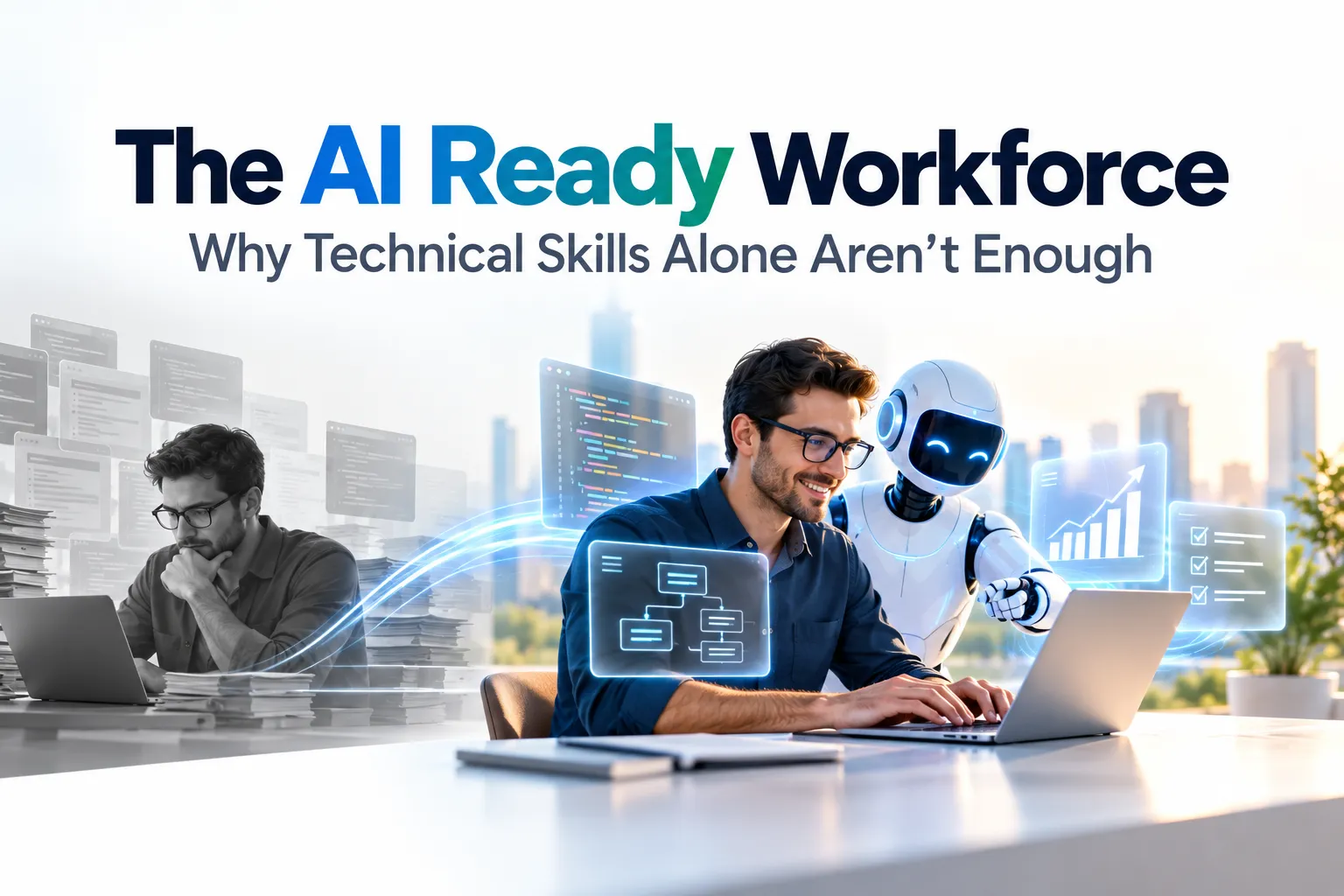
AI is changing how businesses operate, but it's also changing what companies expect from their technical teams.
A few years ago, hiring a strong developer, QA engineer, or business analyst was largely about finding someone with the right technical skills and experience. Those things still matter, but there's another factor becoming increasingly important: Can this person use AI to work smarter and deliver better results?
Companies are investing in AI tools, experimenting with automation, and looking for ways to improve productivity. But simply giving employees access to AI doesn't automatically translate into better business outcomes.
The real opportunity comes from having people who know how to put those tools to work.
That's why AI-ready technical talent is becoming an important part of enterprise hiring and delivery strategies.
Technical Skills Alone Aren't the Whole Picture Anymore
Let's say two developers have similar experience, work with the same technologies, and understand the same development processes.
One approaches every task manually.
The other uses AI to help analyze code, generate initial frameworks, troubleshoot issues, create tests, and streamline documentation.
Both may be capable engineers, but the second developer has opportunities to reduce repetitive work and spend more time solving complex problems.
The same concept applies across technical roles.
QA engineers can use AI to accelerate test creation and identify potential coverage gaps. Business analysts can turn meeting notes into structured requirements faster. Product Owners can improve backlog preparation, while IT teams can automate repetitive support and operational tasks.
The difference isn't necessarily technical ability. It's how effectively that ability is amplified by AI.
For enterprises managing large technology teams, those efficiencies can add up quickly.
The Challenge: AI Adoption Doesn't Automatically Mean AI Productivity
Most organizations recognize that AI has potential. Many have already invested in tools such as GitHub Copilot, Microsoft Copilot, and other AI-powered platforms.
But adoption and execution are two different things.
Some employees use AI regularly. Others barely touch it. Some teams have established repeatable workflows, while others are still experimenting without much consistency.
That creates a challenge for leadership.
How do you ensure AI investments are improving productivity rather than simply adding another technology expense?
The answer isn't necessarily to buy more tools.
It's to bring together the right technology, people, and processes.
AI-ready professionals understand where AI can accelerate their work, where human judgment is still required, and how to incorporate these capabilities into existing delivery workflows.
That combination is what turns AI from an interesting tool into a practical business advantage.
What AI-Ready Talent Looks Like in Practice
AI-ready talent doesn't mean every technical professional needs to become an AI engineer.
It means professionals across different disciplines should understand how AI can improve the work they're already responsible for.
Consider a few examples.
Software Engineering
Developers can use AI-assisted engineering tools to accelerate repetitive coding tasks, understand unfamiliar applications, generate test cases, support refactoring, and improve documentation.
Instead of spending hours building routine components from scratch, engineers can use AI to create a starting point and focus their expertise on architecture, security, performance, and business requirements.
The result can be faster development cycles and more time spent on higher-value engineering work.
Quality Assurance and Test Automation
QA teams often spend significant time creating test cases, maintaining automation scripts, reviewing failures, and investigating defects.
AI can help accelerate test development, identify potential gaps in coverage, and support troubleshooting.
That doesn't eliminate the need for experienced QA professionals. It gives them another way to improve coverage and efficiency while maintaining appropriate validation and oversight.
Product Owners and Business Analysts
Product and business teams deal with a constant flow of requirements, stakeholder feedback, documentation, and backlog management.
AI can help organize information, draft user stories, improve acceptance criteria, and summarize complex discussions.
This can reduce administrative work and give teams more time to focus on priorities, stakeholder alignment, and delivering business value.
IT and Operations
IT and operations teams can also benefit from AI-ready resources.
Think about repetitive reporting, system monitoring, data analysis, documentation, and manual workflows that consume valuable employee time.
Professionals who understand both the business process and the available AI capabilities are better positioned to identify opportunities for automation.
In many cases, those opportunities can lead to improvements that extend well beyond the individual's role.
Ciberspring's Approach: Combining Technical Talent With AI-Enabled Delivery
At Ciberspring, we see AI-ready talent as an important part of how organizations can modernize technical delivery.
Our approach combines technical resources with opportunities to incorporate AI-assisted workflows, automation, and more efficient delivery practices.
That means helping organizations find professionals who bring the necessary technical expertise while also understanding how AI can support their day-to-day responsibilities.
And when the opportunity extends beyond individual productivity, Ciberspring's AI as a Service capabilities can help organizations develop custom solutions that address broader business challenges.
The objective isn't simply to place another resource or introduce another AI tool.
It's to help companies get more value from their technology investments and the people responsible for delivering them.
Looking to Build a More AI-Ready Technical Team?
Whether you're expanding your engineering team, improving delivery efficiency, or exploring how AI can support existing resources, Ciberspring can help you identify practical opportunities.
Connect with Ciberspring to schedule a conversation.
Why This Matters for Enterprise Leaders
The business case for AI-ready talent becomes particularly interesting when you look beyond individual productivity.
For a CIO or CTO, the priority may be delivering more technology initiatives without continuously expanding headcount.
For an engineering leader, it may be reducing development bottlenecks and improving sprint execution.
For a QA leader, it could mean increasing automation coverage while reducing time spent on repetitive testing activities.
For an operations executive, the opportunity may involve eliminating manual processes that have existed for years.
And for finance leaders, it comes down to understanding whether technology investments are generating measurable returns.
AI-ready resources can contribute to these objectives by improving how work gets done.
But there's an important distinction: using AI doesn't automatically make someone more productive.
Organizations still need strong technical fundamentals, appropriate oversight, secure development practices, and clear ways to measure results.
The goal is better execution, not simply more AI usage.
Moving Beyond Traditional Staff Augmentation
Traditional staff augmentation has generally focused on adding capacity.
A company needs more development support, so it adds developers. Testing requirements increase, so it brings in additional QA engineers.
That model continues to serve an important purpose.
But AI introduces an opportunity to think differently about resource planning.
Instead of only asking how many people are needed to complete a project, organizations can also ask how AI-enabled workflows might improve the output of the team.
Could repetitive engineering tasks be accelerated? Could documentation be generated more efficiently? Could test automation be improved? Could manual reporting be reduced?
These questions create opportunities to improve delivery without automatically assuming that every increase in workload requires a proportional increase in staffing.
AI-ready talent can help organizations make that transition.
And in some cases, the best solution may not be adding another resource at all.
It may be building an automation or AI-powered application that removes the repetitive work entirely.
That's where Ciberspring's combination of technical staffing, AI as a Service, and custom solution development becomes particularly relevant.
Measuring the Impact of AI-Ready Talent
As companies incorporate AI into technical delivery, it's important to evaluate results using practical business metrics.
For engineering teams, that might include development cycle times, completed work, defect rates, and time spent on repetitive tasks.
For QA teams, it could include test coverage, automation maintenance effort, and defect resolution times.
For product teams, it may involve backlog readiness, documentation quality, and time required to prepare requirements.
And for operations teams, it could be as straightforward as measuring the number of manual hours eliminated through automation.
The specific metrics will vary, but the principle remains the same.
AI should be measured by the improvements it creates, not simply by how often employees use it.
That mindset helps organizations make more informed decisions about technology, staffing, and future investment.
The Future of Technical Talent Is Human Expertise Amplified by AI
AI isn't replacing the need for experienced developers, QA engineers, business analysts, architects, and other technical professionals.
It's changing how those professionals can approach their work.
The strongest technical teams will continue to rely on human judgment, creativity, business understanding, and technical expertise.
AI simply creates opportunities to apply those capabilities more efficiently.
For enterprises, that means looking beyond traditional hiring criteria and considering how AI readiness can contribute to better execution.
It also means working with partners who understand that successful AI adoption requires more than technology alone.
Ciberspring helps organizations connect technical talent, AI-enabled delivery, and custom solutions to practical business needs.
Because the future of technical staffing isn't just about finding people who can do the work.
It's about finding people who can do the work better—with AI helping them get there.
If you're evaluating technical resources or exploring how AI can improve the productivity of your existing teams, reach out to Ciberspring to start the conversation.
Author

Tom Boller Jr.

Sales Director - Digital
Share this article


Speak With Our Team
Share this article