 Adobe
Adobe  Sitecore
  Gradial
  PEGA
PEGA The AI Talent Gap: Why Technical Skills Alone Are No Longer Enough
Aug 17, 2026 | 3 min
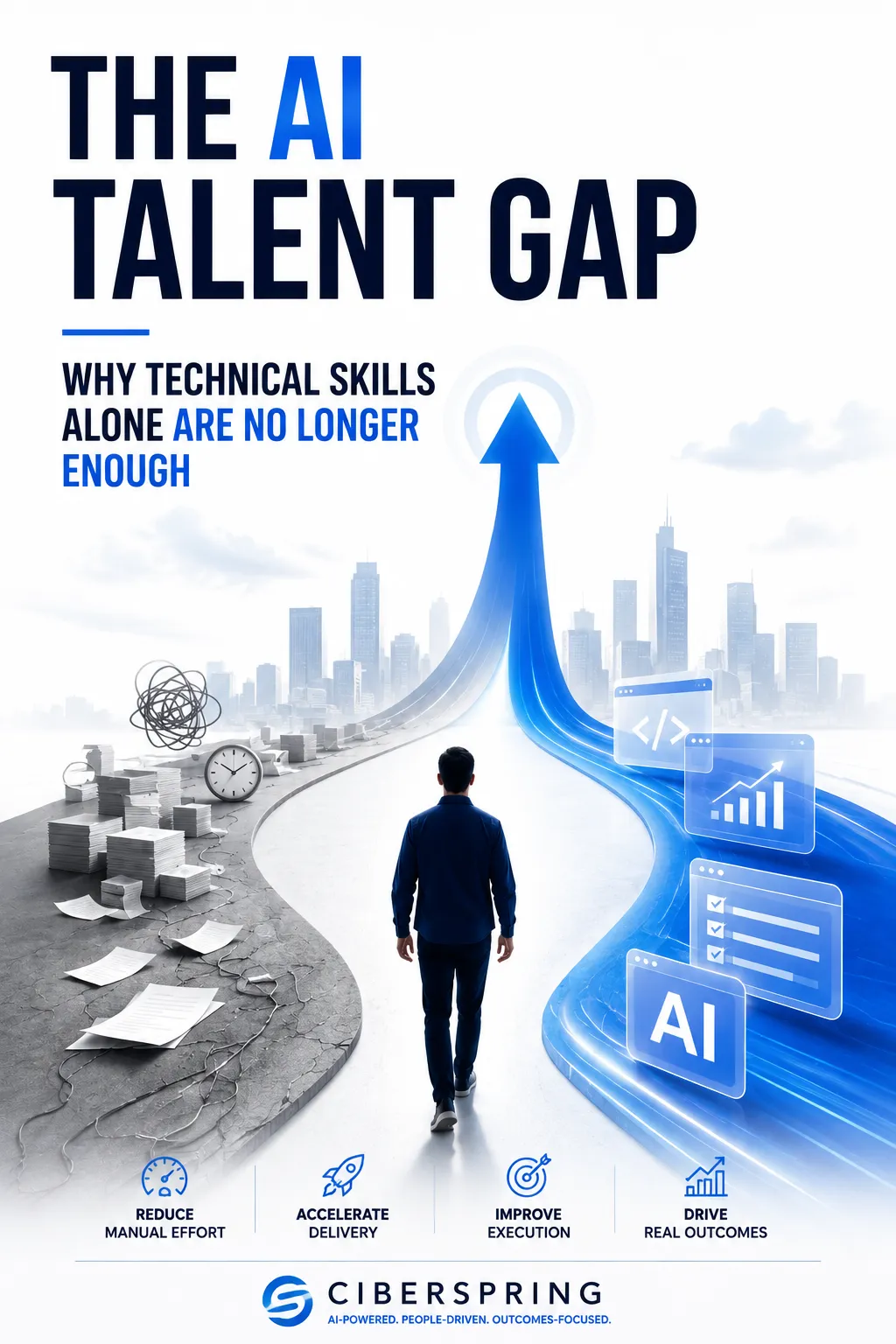
For years, hiring technical talent was largely about matching skills to requirements.
Need a software engineer? Look for the right programming languages and frameworks. Need a QA engineer? Find someone with automation experience. Need a Product Owner? Look for Agile expertise and strong requirements skills.
That formula is changing quickly.
AI is becoming embedded in the way modern technical teams design, build, test, document, analyze, and deliver software. The question is no longer simply whether someone has the technical skills to perform a job.
The better question is:
Can this person use AI to perform that job faster, smarter, and with better outcomes?
That distinction is becoming increasingly important for organizations trying to improve productivity without continuously adding headcount.
Technical Talent Is Entering a New Era
AI isn't eliminating the need for skilled technical professionals. In many cases, it's making great technical talent even more valuable.
But what qualifies as "great" is changing.
Consider two software engineers with similar backgrounds. Both understand the architecture. Both can write high-quality code. Both know the organization's technology stack.
But one engineer also knows how to use AI-assisted development workflows to generate scaffolding, accelerate repetitive coding, analyze a complex codebase, identify potential defects, improve test coverage, assist with documentation, and speed up code reviews.
The difference in output can become significant.
The same principle extends far beyond developers.
A test automation engineer can use AI to help generate tests, identify missing test paths, analyze failures, detect flaky tests, and prioritize testing based on risk.
A Product Owner can use AI to improve requirements, strengthen acceptance criteria, accelerate documentation, and break complex initiatives into clearer user stories.
A Scrum Master can use AI-driven analytics to identify delivery risks, analyze sprint patterns, summarize ceremonies, and surface recurring impediments.
The strongest technical teams aren't simply adopting AI tools.
They're redesigning how work gets done around them.
The Business Problem: More Technology Doesn't Automatically Mean More Productivity
Organizations have invested heavily in AI tools.
The problem is that giving technical teams access to AI doesn't automatically create better outcomes.
A developer having access to an AI coding assistant doesn't necessarily mean development cycles become shorter. A QA engineer having access to AI doesn't automatically improve test coverage. A Product Owner using an AI assistant doesn't guarantee better requirements.
The value comes from how those capabilities are integrated into the actual delivery process.
That means organizations increasingly need professionals who combine three things:
- Strong foundational technical expertise
- The ability to work effectively with AI-enabled tools and workflows
- The judgment to know where AI should — and shouldn't — be used
This creates a new challenge for technology leaders.
Traditional resumes and job descriptions may tell you what technologies someone has worked with. They don't always tell you whether that person knows how to operate in an AI-enabled delivery environment.
AI-First Talent Is About Leverage
The goal isn't to find people who can talk about AI.
It's to find people who can use AI to create leverage.
That leverage might mean reducing repetitive development work. It might mean identifying defects earlier. It could mean accelerating documentation, improving backlog readiness, automating manual processes, or reducing the time required to move an initiative from concept to production.
For example, modern engineering teams can increasingly use agent-based AI workflows to assist with code generation, refactoring, testing, documentation, and analysis.
QA teams can use AI-assisted workflows to generate and maintain tests, analyze failures, identify risk, and improve coverage.
Product and Agile teams can use AI to strengthen requirements, summarize complex information, identify delivery risks, and improve communication across distributed teams.
The business outcome isn't "we're using AI."
The outcome is less manual effort, shorter delivery cycles, better quality, and more predictable execution.
Ciberspring Helps Organizations Build AI-Enabled Delivery Teams
This is where Ciberspring's approach goes beyond simply providing technical resources.
We help organizations build and support teams that can operate effectively in an AI-enabled delivery model.
That can include software engineers who incorporate AI-assisted development into their workflows, QA engineers using AI to accelerate automation and defect detection, Product Owners using AI to improve requirements and backlog quality, and delivery leaders using AI-driven insights to improve predictability.
The objective is not AI for AI's sake.
It's helping organizations create teams that can deliver more effectively.
Through AI as a Service, technical delivery support, automation, managed services, and AI-enabled technical talent, Ciberspring can help organizations determine where AI creates meaningful leverage and then put the people and processes in place to execute.
If you're evaluating how AI should change your technical organization — or what your next generation of technical talent should look like — schedule time with Ciberspring.
What Should Leaders Look for in AI-Enabled Technical Talent?
The evaluation criteria need to evolve.
Technical fundamentals still matter. In fact, they may matter even more because professionals need enough expertise to evaluate what AI produces rather than blindly accepting it.
But leaders should also look for people who understand how to incorporate AI into real workflows.
Can an engineer use AI to accelerate development while maintaining security, architecture, and coding standards?
Can a QA professional use AI to increase automation without creating unreliable tests?
Can a Product Owner use AI to create clearer requirements without losing the business context behind them?
Can delivery leaders use AI-generated insights while still applying human judgment?
These are increasingly important questions.
The best candidates won't simply say, "I've used Copilot."
They'll be able to explain what they changed, what they automated, what became faster, and what business or delivery outcome improved as a result.
AI Changes the Economics of Technical Teams
This shift has implications beyond hiring.
If AI allows highly capable technical professionals to accomplish more, organizations may not need to solve every capacity problem by adding another person.
Instead, leaders can start asking:
Where can AI increase the output of the team we already have?
A development team may be able to automate repetitive engineering tasks.
A QA organization may be able to expand automated coverage without proportionally expanding headcount.
An operations team may be able to automate reporting, analysis, and routine workflows.
A distributed engineering organization may use AI to improve documentation and handoffs across time zones.
The opportunity is not simply reducing costs.
It's creating more productive technical organizations.
That can mean faster releases, fewer defects, less operational friction, stronger documentation, better visibility, and more time for employees to focus on higher-value work.
From AI Experimentation to AI-Enabled Execution
Many organizations already have AI initiatives underway.
The next challenge is turning those initiatives into the normal way work gets done.
That requires more than software licenses.
It requires the right people, workflows, governance, automation, and technical execution.
Organizations that recognize this early will increasingly build teams where AI is simply part of the delivery model — just as cloud, DevOps, Agile, and automation became fundamental parts of modern technology organizations.
The companies that get the most value from AI won't necessarily be the companies with the most AI tools.
They'll be the companies with the people who know how to use those tools to produce better outcomes.
The New Standard for Technical Talent
The definition of technical talent is changing.
Deep technical expertise still matters. Business understanding still matters. Communication, judgment, and execution still matter.
But increasingly, another capability sits alongside them:
The ability to use AI to amplify everything else.
That's the new competitive advantage.
Ciberspring helps organizations bridge the gap between AI potential and real-world execution through AI as a Service, AI-enabled technical talent, managed services, automation, and hands-on delivery support.
If you're thinking about how your engineering, IT, product, or operations teams need to evolve in the age of AI, connect with Ciberspring to discuss where AI can create measurable impact across your organization.
Author

Tom Boller Jr.

Sales Director - Digital
Share this article


Speak With Our Team
Share this article