 Adobe
Adobe  Sitecore
  Gradial
  PEGA
PEGA The New Technical Contractor: Human Expertise, Amplified by AI
Sep 14, 2026 | 3 min
For years, adding contractors has been one of the fastest ways for companies to expand capacity. Need another developer? Add a developer. Need more QA coverage? Bring in a test engineer. Have a backlog piling up? Add resources until the team catches up.
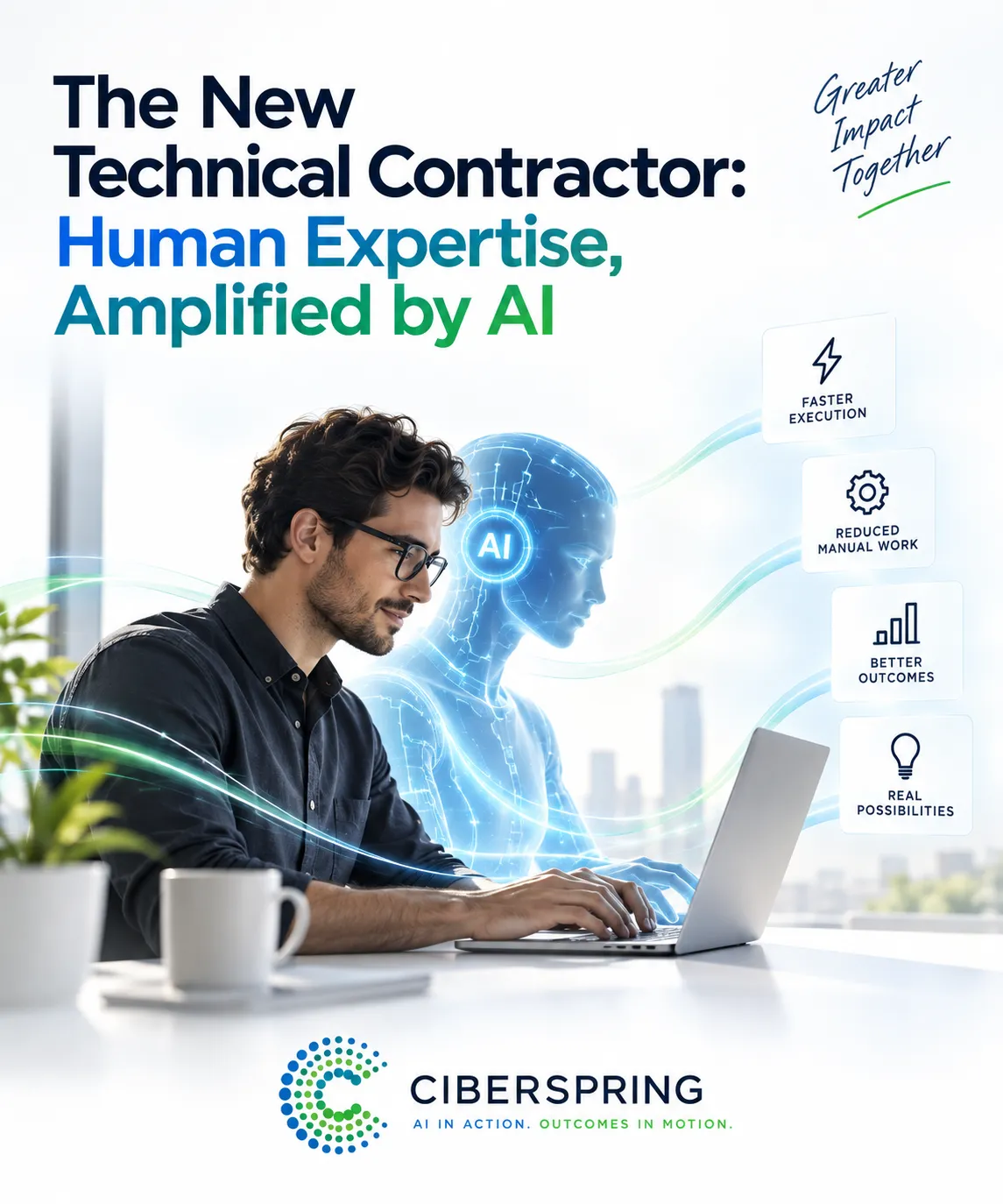
That model still works—but AI is changing what companies should expect from every person they add to a team.
The next generation of technical talent isn't simply completing assigned work. AI-enhanced resources are using AI to accelerate execution, automate repetitive tasks, improve quality, and increase the amount of business value they can deliver.
For organizations already investing heavily in contractors and consulting resources, that creates an important question:
Are you paying for more people—or more output?
The Traditional Contractor Model Has a Ceiling
Traditional staffing is largely based on capacity.
A contractor joins the team, receives work, and contributes a certain number of hours each week. Adding capacity usually means adding another person.
But much of a technical resource's day isn't spent exclusively on high-value work.
Developers write documentation, investigate unfamiliar code, create repetitive scaffolding, troubleshoot errors, write tests, and review changes. QA engineers create test cases, analyze failures, maintain automation, and document results. Business analysts translate meetings and requirements into stories, acceptance criteria, and documentation.
These activities are necessary, but many are also increasingly AI-assisted.
That changes the economics of technical staffing.
Instead of asking how many tasks one contractor can complete manually, companies can begin asking how much more effectively that person can operate when AI is embedded into their workflow.
What Is an AI-Enhanced Resource?
An AI-enhanced resource isn't simply someone who knows how to use ChatGPT.
It's a professional who understands their core discipline—software engineering, QA, product, data, architecture, operations—and knows how to apply AI appropriately throughout their workflow.
The human still owns the outcome. AI helps accelerate the work required to get there.
For a software engineer, that could mean using AI to understand an unfamiliar codebase, generate scaffolding, assist with refactoring, strengthen test coverage, analyze code changes, or accelerate documentation.
For a QA engineer, AI can help generate test scenarios, identify missing coverage, analyze logs, cluster failures, and accelerate root-cause analysis.
For a Product Owner or Business Analyst, it can help turn complex requirements into clearer user stories, improve acceptance criteria, summarize stakeholder input, and reduce documentation time.
The value isn't simply "using AI."
It's getting more high-quality work done with the same—or potentially fewer—resources.
From Individual Productivity to Better Delivery
Productivity is only part of the equation.
If AI saves an engineer several hours but doesn't improve delivery, the business value is limited.
The bigger opportunity is using those efficiencies across the delivery lifecycle.
Imagine an engineering team preparing a new feature. AI-enhanced resources can potentially accelerate requirements analysis, development, test creation, documentation, code review, troubleshooting, and release preparation.
Each improvement may seem incremental on its own. Combined across a team and multiple sprints, they can materially affect delivery speed.
That can mean:
shorter development cycles, fewer repetitive tasks, faster troubleshooting, stronger documentation, better test coverage, and more time focused on higher-value problems.
This is where AI-enhanced staffing becomes different from simply giving employees access to another productivity tool.
It becomes part of the delivery model.
Ciberspring's Approach: People + AI + Execution
At Ciberspring, we believe companies shouldn't have to choose between adding technical talent and adopting AI.
The two can work together.
Ciberspring can provide technical resources while helping organizations incorporate AI-enabled practices into how those resources operate. That creates an opportunity to improve existing delivery today while also helping teams develop more mature AI capabilities over time.
And when the opportunity goes beyond individual productivity, Ciberspring can help move into broader AI as a Service, automation, managed services, and custom technical execution.
The goal is not AI for AI's sake.
It's identifying where AI can remove friction and then putting the technology, processes, and people in place to produce a measurable result.
If you're evaluating technical resources or wondering how AI could improve the productivity of your existing delivery teams, connect with Ciberspring to discuss your goals.
What This Looks Like in Practice
Consider a few common enterprise scenarios.
An engineering leader has a growing backlog but doesn't necessarily want to keep increasing headcount. Instead of simply adding developers, the organization can introduce engineers who are comfortable using AI-assisted workflows to accelerate coding, testing, documentation, and analysis.
A QA leader needs to increase automation coverage without dramatically expanding the testing team. AI-enhanced QA engineers can use automation and AI together to accelerate test creation, identify coverage gaps, and spend less time manually investigating failures.
An IT leader has multiple teams experimenting independently with AI tools but no consistent execution model. Ciberspring can provide resources while helping establish repeatable AI-enabled workflows and identify opportunities for broader automation.
An operations leader has employees spending hours moving between spreadsheets, systems, reports, and manual analysis. That may require more than an AI-enhanced contractor. It could become an opportunity to automate the process entirely through an AI-powered solution.
That last example is particularly important.
Sometimes the Best Resource Isn't Another Resource
AI-enhanced talent can make individual people more productive, but companies should also look beyond productivity.
If five people are repeatedly performing the same manual process, the answer may not be to make all five people 20% faster.
The better answer might be to automate a large portion of the process.
That's where staffing and AI as a Service can start to converge.
A technical resource embedded within an organization can identify repetitive processes, bottlenecks, and opportunities that aren't always visible from the outside. Ciberspring can then help determine whether those opportunities should be solved through better workflows, automation, AI agents, custom applications, managed services, or a combination of approaches.
The resource doesn't just help execute today's work.
They can help uncover how tomorrow's work should be done differently.
Measuring Resources by Outcomes, Not Just Hours
The contractor model isn't disappearing. But the way companies evaluate contractors should evolve.
Hours worked and tasks completed will continue to matter. Increasingly, though, organizations should also consider questions like:
How much manual effort was eliminated? How much faster did the team deliver? Did quality improve? Were repetitive processes automated? Did AI allow the resource to spend more time on higher-value work? Did the engagement create reusable capabilities that remain after the project?
Those are business outcomes.
And ultimately, they're far more important than whether someone worked 40 hours.
The Future Is AI-Enhanced Delivery
AI won't eliminate the need for talented engineers, analysts, QA professionals, product leaders, and other technical specialists.
It will change what organizations should expect from them.
The strongest resources will combine domain expertise, technical capability, AI fluency, and business understanding to accomplish more than traditional delivery models allow.
For companies, that creates an opportunity to rethink staffing from a capacity conversation into an execution conversation.
Don't just ask:
"How many resources do we need?"
Start asking:
"How much more can the right resources accomplish?"
That's where Ciberspring's combination of technical talent, AI as a Service, automation, managed services, and hands-on delivery can help bridge the gap between AI experimentation and measurable business outcomes.
If you're looking to augment your team—or want to explore how AI can increase the output of the resources you already have—reach out to Ciberspring to start the conversation.
Author

Tom Boller Jr.

Sales Director - Digital
Share this article


Speak With Our Team
Share this article