 Adobe
Adobe  Sitecore
  Gradial
  PEGA
PEGA What Are AI Agents and Why Should Your Business Care?
Jun 24, 2026 | 7 min read
TL;DR
An AI agent monitors a data source, makes decisions based on what it finds, takes defined actions, and hands off results without a human triggering each step. It’s not a chatbot, and it’s not traditional automation. Gartner projects 40% of enterprise applications will run task-specific AI agents by end of 2026, up from under 5% in 2025. The gap between companies building real agent workflows and those still watching demos is widening.
Most leadership teams we talk to carry the same mental picture of an AI agent: a smarter chat window, maybe one that can do more than answer questions. That picture is wrong, and it’s costing companies time they don’t have.
“AI agent” sounds like it lives somewhere between Siri and a sophisticated bot. But the technology works in a fundamentally different way, and once you see the actual mechanics, the business case comes into focus quickly.
What is an AI agent, exactly?
An AI agent perceives its environment, makes decisions based on what it observes, executes one or more actions, and returns a result without requiring a human to initiate each step. The four-part loop: perceive, decide, act, hand off. That loop runs continuously against whatever data sources and systems you give the agent access to, within whatever guardrails you define.
A useful shorthand: a chatbot waits for your question. An agent runs a job on your behalf. You configure what it watches, what it does when it finds something, and where the result goes.
How is an AI agent different from a chatbot?
A chatbot processes a single input and returns a single output. You type a question, it generates an answer. No memory, no follow-through, no background activity between conversations.
An agent operates on a timeline. It has a goal, access to tools, and the ability to take sequential actions to complete a workflow, calling APIs, reading documents, writing records, sending notifications, and routing escalations, all as part of a single run without human involvement.
The practical difference shows up in a pharmaceutical commercial operations example. A chatbot can help a brand manager find information about a formulary change, but only if the manager knows to ask and has time to dig for the document. An agent watches the formulary source continuously, detects the change the moment it publishes, classifies the impact by drug and coverage tier, and routes a recommended response to the right team member before anyone’s morning standup. Same underlying technology. Entirely different operational result.
For a production example of how this plays out inside a CRM platform, How Does Salesforce Agentforce Work? walks through the decision logic Agentforce uses to move from observation to action inside Salesforce.
How is an AI agent different from traditional automation?
Traditional automation follows a script: if X happens, do Y. The logic runs correctly as long as inputs match what the script anticipated. When something falls outside the script, the process stops or fails silently.
An agent exercises judgment. It evaluates context, selects from a range of possible actions based on what it observes, and handles variation without requiring a new rule for every edge case. The test Craig Taylor uses with clients: is your AI following a flowchart, or is it reading the situation and choosing what to do?
Robotic process automation (RPA) works well for high-volume, fully structured processes where every step is already mapped. Agents work better where inputs vary, context changes, or the right action depends on more than a single trigger condition. The two can coexist: RPA handles structured execution while an agent manages judgment calls around it.
What changed in 2026?
Two things converged. LLM reasoning quality crossed a practical threshold: models now handle ambiguous inputs reliably enough for business use, meaning agents can interpret natural language documents, classify edge cases, and make defensible decisions without constant human correction.
Orchestration tooling also matured. Platforms like LangGraph, AutoGen, Salesforce Agentforce, and Microsoft Copilot Studio give operations teams the infrastructure to build, deploy, and govern agents without a specialized AI engineering team. A well-scoped agent deployment now takes weeks, not quarters.
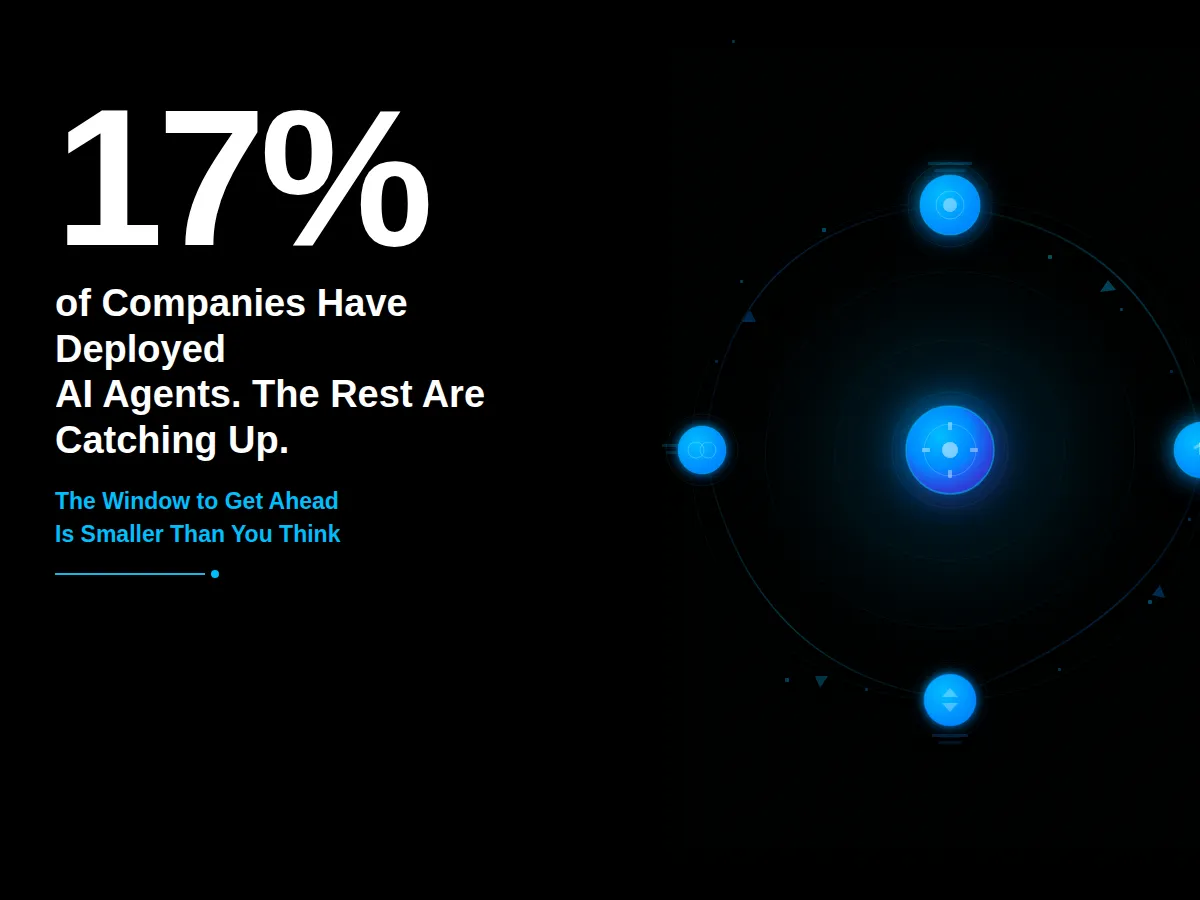
Gartner’s numbers reflect both shifts. The firm projected 40% of enterprise applications will run task-specific AI agents by end of 2026, up from under 5% in 2025. The 2026 Hype Cycle for Agentic AI shows only 17% of organizations have deployed agents to date, with more than 60% expecting to do so within two years. For a deeper look at what operational readiness requires, see Building the Agentic Enterprise: What It Actually Takes.
Where do AI agents create the most value in a business?
CI builds production agent systems for clients in life sciences, financial services, and insurance. Five categories produce the most consistent returns.
Document monitoring and classification. Agents watch regulatory sources, policy documents, or internal repositories for changes, classify the significance, and route relevant items to the right people. The pharma formulary example above falls here.
Workflow routing and triage. Agents review incoming requests, match them against defined criteria, and direct them to the correct queue or team without manual intake. Medical inquiry routing, insurance claims intake, and IT ticket triage all follow this pattern.
Data reconciliation across systems. Agents pull records from multiple systems, identify discrepancies, apply defined resolution logic, and flag exceptions for human review, replacing hours of manual spreadsheet work in finance and compliance.
Proactive alerting with recommended actions. Rather than sending a raw alert, an agent detects a condition worth attention and surfaces a recommended response. The human confirms or adjusts rather than starting from scratch.
Handoff coordination between teams. Agents manage information exchange at workflow handoff points, package context for the next owner, log the transfer, and follow up if no action occurs within a defined window.
What does it take to make an agent actually work?
Gartner projects that more than 40% of agentic AI projects will fail or close by end of 2027, primarily due to unclear business value, poor data quality, or inadequate risk controls. That failure rate isn’t a technology problem. It’s a process problem.
Most failed deployments share three gaps. They automate a process nobody fully defined. They assume their data is cleaner than it is. And they never establish where a human stays in the loop.
The first gap is the most common. Teams build an agent against the documented workflow and discover that the actual work involves undocumented judgment calls that exist only in people’s experience. The agent fails on edge cases, trust erodes, and the project stalls. Mapping what actually happens before writing agent logic is mandatory.
The data quality gap follows the same logic. Agents make decisions based on what they read. If the records are incomplete or structured differently across systems, the agent’s decisions reflect those problems at scale.
The governance gap is where risk lives. An agent acting without defined boundaries, audit trails, or escalation paths creates liability that surfaces after go-live. For a detailed treatment of what governance infrastructure looks like in practice, see The Control Layer: Mastering Governance in Agentic AI.
The companies making agents work did the boring work first: process documentation, data audit, governance design, human-in-the-loop definition. The agent build is usually the fastest part.
Frequently asked questions about AI agents
What is the simplest definition of an AI agent?
An AI agent watches a data source or environment, makes decisions based on what it finds, takes defined actions, and hands off results without a human initiating each cycle. Unlike a chatbot, it runs continuously on your behalf rather than waiting for a question.
Can a small or mid-size company use AI agents?
Yes. The cost and complexity dropped significantly between 2024 and 2026. Mid-market companies often move faster than enterprise because they have fewer legacy systems and shorter approval chains.
What’s the difference between an AI agent and RPA?
RPA follows a fixed script for structured, high-volume processes where every step is fully mapped. An AI agent exercises judgment, handles variation, and selects actions based on context. The two work well together in the same workflow.
How long does a first AI agent deployment take?
A realistic first deployment takes 60 to 90 days for a well-scoped single workflow: process mapping and data audit (weeks 1 to 4), agent build and shadow-mode testing (weeks 5 to 8), and supervised production (weeks 9 to 12). Teams that skip the first phase typically restart after the agent ships with errors.
Author

Craig Taylor

Share this article


Subject Matter Expert

Craig Taylor
Practice Lead, CI Digital
Speak With Our Team
Share this article