 Adobe
Adobe  Sitecore
  Gradial
  PEGA
PEGA Who Should Get an EV First? Rethinking Fleet Electrification With Data
Aug 31, 2026 | 3 min
Fleet electrification sounds straightforward at the strategic level: replace traditional vehicles with EVs, reduce emissions, lower operating costs, and move closer to sustainability targets.
The challenge starts when organizations try to execute.
A field employee driving primarily through a dense urban territory has a very different experience from someone covering hundreds of miles across a rural region. Charging availability varies. Mileage varies. Routes vary. Territory requirements vary. Yet many organizations are still forced to make fleet decisions using broad policies and generalized assumptions.
That creates a more important question than simply, “How quickly can we transition our fleet to EVs?”
The better question is: “Which employees should transition first?”
For enterprises managing hundreds or thousands of field vehicles, answering that question with data can make the difference between an EV program that delivers measurable business value and one that creates unnecessary cost and operational headaches.
The Problem With One-Size-Fits-All Fleet Electrification
Large organizations often establish company-wide EV targets because they need a clear path toward sustainability goals. But a national or regional mandate doesn't necessarily reflect what employees experience in the field.
Some employees may drive 150 miles per week while others drive 600. Some operate in areas surrounded by charging infrastructure, while others cover territories where reliable charging is limited.
Treating those employees identically introduces risk.
An EV assigned to the wrong employee can create range concerns, charging complications, lost productivity, vehicle reassignment costs, and frustration for the employee. At the same time, delaying EV adoption for employees who are strong candidates means leaving potential fuel, maintenance, and emissions savings on the table.
The problem isn't necessarily the EV strategy. It's the lack of intelligence behind the sequencing.
Moving From Fleet-Level Decisions to Employee-Level Decisions
A more practical approach is to evaluate EV readiness at the individual level.
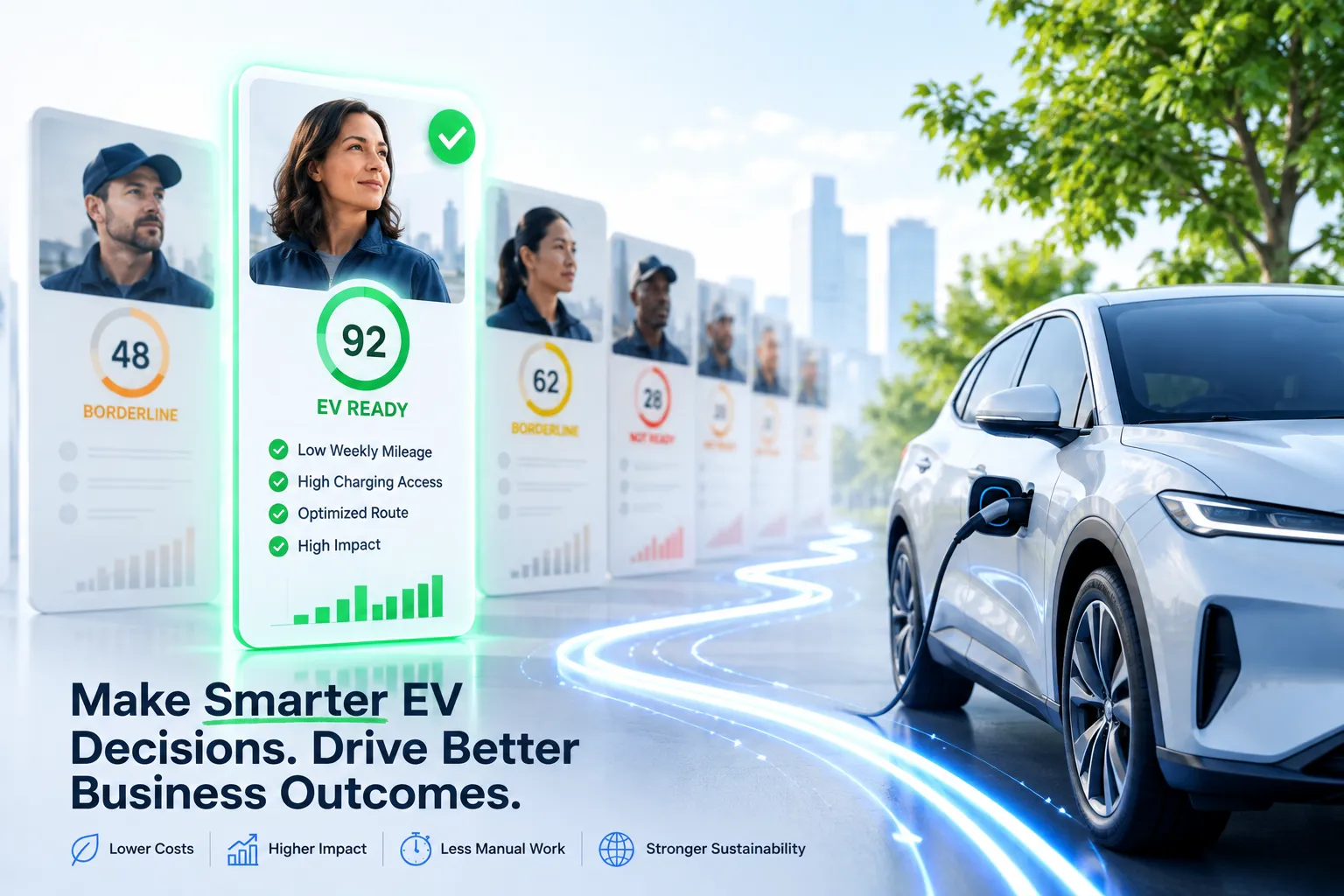
Ciberspring's Fleet Intelligence solution was designed around this concept. Instead of applying the same assumption across an entire field organization, the platform analyzes individual employees and territories and produces an EV viability score.
The current scoring model evaluates factors including charging density, weekly mileage, territory priority, and geographic access. Those inputs produce a configurable 0-to-100 score that can help distinguish strong EV candidates from borderline cases and employees for whom an EV may not currently make sense.
That changes the conversation from:
“We need to convert 500 vehicles this year.”
to:
“Which 500 vehicles should we convert first to generate the best operational and financial outcome?”
That is a much more useful business question.
Turning Existing Fleet Data Into Action
The good news is that organizations don't necessarily need to launch a massive data-transformation initiative before they can start making better fleet decisions.
Fleet Intelligence can begin with existing employee, roster, and territory information. The platform processes the data, applies its scoring methodology, and generates individual recommendations. In the current solution, a roster can be uploaded, scored, analyzed at the individual level, and turned into an exportable fleet report for stakeholder review.
That can significantly reduce the manual work required from fleet and sustainability teams.
Instead of analysts repeatedly reviewing spreadsheets, looking up charging availability, comparing territories, evaluating mileage, and manually developing recommendations, much of that process can be automated.
The result isn't simply another dashboard. It's a decision-support system designed to help teams determine who should transition, who shouldn't, and why.
Want to see what this could look like across your fleet?
Ciberspring helps organizations move beyond AI concepts and build practical solutions tied to real operational challenges. If you're evaluating fleet electrification or trying to determine how AI can improve fleet decision-making, schedule a conversation with Ciberspring.
Why Explainability Matters
Scoring employees is only valuable if decision-makers understand what the scores mean.
Imagine two employees:
Employee A drives relatively low weekly mileage, works in a territory with strong charging coverage, and operates primarily in a dense geographic area.
Employee B drives significantly more miles, covers a large rural territory, and has limited charging availability.
A blanket EV policy may treat them the same. A data-driven model shouldn't.
More importantly, the system should be able to explain why Employee A is a stronger candidate.
That's why Fleet Intelligence goes beyond the initial scoring layer. Its reasoning layer can evaluate scored results and generate individual analysis incorporating territory context, risk factors, and specific recommendations.
For fleet managers, that provides something particularly important: a defensible rationale behind each decision.
The Business Case Goes Beyond Sustainability
EV electrification is frequently positioned primarily as an ESG initiative. Sustainability matters, but the financial and operational opportunities can be equally important.
A smarter deployment strategy can help organizations avoid poor vehicle placements, accelerate fuel and maintenance savings, reduce manual analyst work, and automate parts of ESG reporting. Those are all value categories incorporated into the business case developed alongside Fleet Intelligence.
Consider the operational impact.
If an organization knows its strongest EV candidates today, it can prioritize those employees in the first deployment wave. Borderline employees can potentially be reconsidered as charging infrastructure improves. Employees whose territories currently make EV adoption impractical can remain on another vehicle strategy rather than forcing a transition that creates more problems than it solves.
That allows sustainability goals and operational realities to work together instead of competing with each other.
Fleet Electrification Should Be Dynamic
There's another problem with a traditional fleet assessment: the answer doesn't stay the same.
Employees change territories. Mileage changes. Charging networks expand. Vehicle capabilities improve. Energy and fuel economics change.
Someone who isn't a strong EV candidate today could become an excellent candidate a year from now.
That creates an opportunity to move from a one-time fleet assessment toward continuous fleet intelligence. The Fleet Intelligence roadmap, for example, contemplates capabilities such as automatic rescoring after territory changes, carbon and ESG reporting, EV-versus-low-emission cost assessments, executive ROI dashboards, telematics integration, and connections with HR and fleet systems.
Instead of periodically rebuilding the analysis manually, organizations can work toward an environment where decisions continuously adapt as the underlying data changes.
From an AI Idea to a Working Business Solution
This is where AI becomes useful—not because an organization can say it's using AI, but because AI can reduce manual effort and improve a real business process.
Ciberspring's approach is centered on taking use cases like fleet electrification from idea through technical execution. That can include solution design, data integration, automation, AI implementation, deployment, and ongoing support.
Fleet Intelligence demonstrates what that can look like in practice: take an operational problem with many variables, combine enterprise data with relevant external information, automate analysis, apply AI-powered reasoning, and give decision-makers a clear recommendation.
The underlying principle extends well beyond EVs.
AI creates the most value when it helps people make better decisions and makes those decisions easier to execute.
Start With the Right Vehicles, Not Just More Vehicles
The race toward fleet electrification isn't simply about getting more EVs on the road.
It's about putting the right vehicles with the right employees at the right time.
Organizations that approach the transition with employee-level intelligence can prioritize stronger candidates, reduce operational risk, decrease manual analysis, better support sustainability objectives, and build a clearer business case for continued investment.
Ciberspring's Fleet Intelligence solution is designed to help organizations make that transition using data rather than intuition.
If you're evaluating an EV transition—or want to explore how AI could make your existing fleet strategy smarter—contact Ciberspring to start the conversation.
Author

Tom Boller Jr.

Sales Director - Digital
Share this article


Speak With Our Team
Share this article