
 Adobe
Adobe  Sitecore
  Gradial
  PEGA
PEGA What Your Team Actually Needs to Work With AI Agents
Jul 08, 2026 | 7 min read
TL;DR
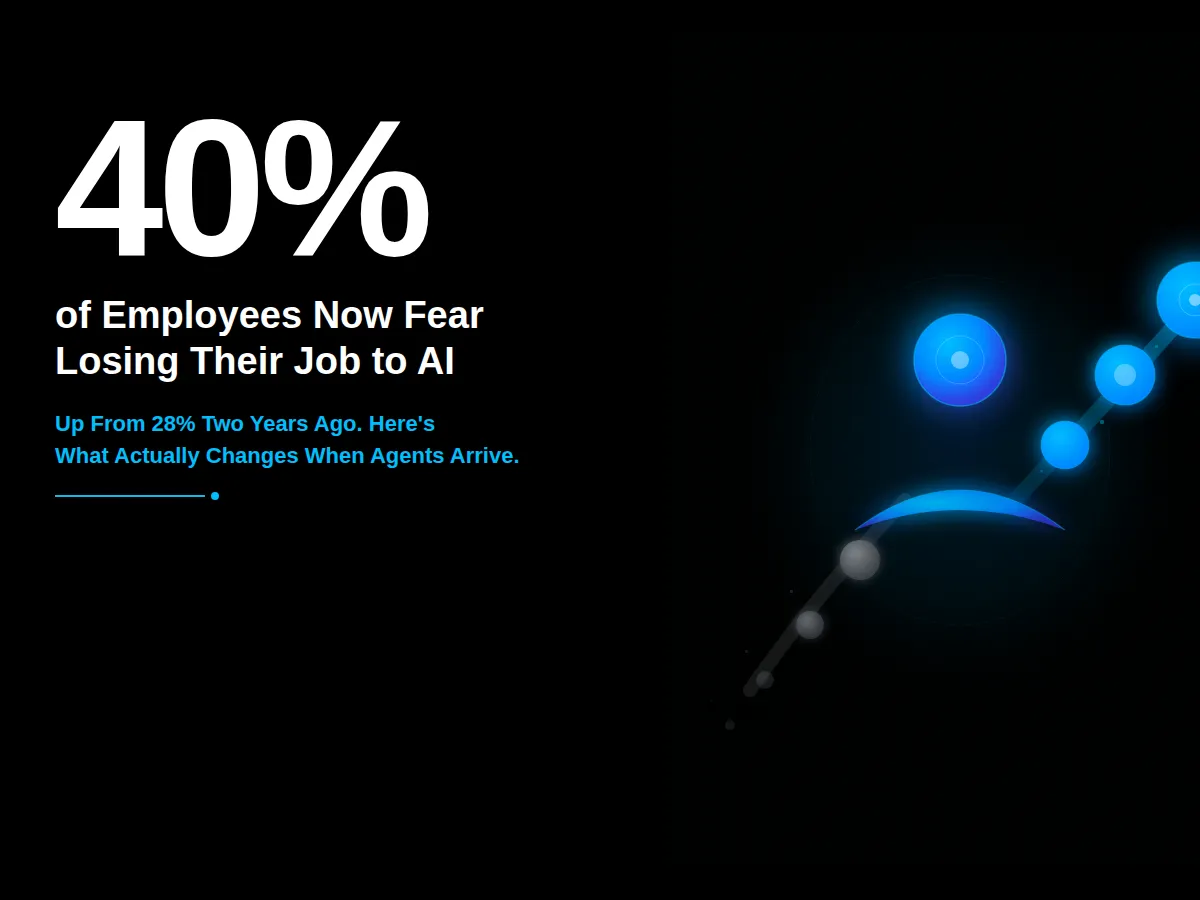
40% of employees now fear losing their job to AI, up from 28% two years ago. Vague reassurance makes this worse, not better. Roles change more often than they disappear, but only if the team understands what's actually shifting. Teams that get clear communication and real skills investment adapt well. Teams that don't quietly resist, and the deployment suffers for it.
Nobody says it out loud in the all-hands meeting. A leader announces a new AI agent is coming to the team's workflow, talks about efficiency and freeing people up for higher-value work, and the room nods along. Underneath that nodding, a real number of people are doing quiet math about their own job security.
That fear isn't irrational, and it isn't going away. Mercer's Global Talent Trends 2026 survey of 12,000 workers found that 40% of employees now fear losing their job to AI, up from 28% just two years earlier. That's a 12-point jump in two years. Any manager rolling out an agent right now is doing it inside a workforce that's more anxious about this exact topic than it's ever been.
Why “don't worry, your job is safe” doesn't work
The instinct to reassure a nervous team is understandable, but generic reassurance rarely lands, because the person hearing it has no way to verify it. “Your job is safe” from a manager who may not fully control that outcome doesn't reduce anxiety. It just tells the team the conversation is over.
The stakes of getting this wrong are higher than most leaders assume. ADP Research's Today at Work 2026 report, surveying more than 39,000 workers across 36 markets, found that only 22% of workers globally strongly agree their job is safe from elimination. Workers who do feel secure are six times more likely to be fully engaged. That gap matters during an agent rollout specifically, because a team that feels unsettled during a transition works differently than a team that understands what's changing and why.
What actually works instead of reassurance is specificity. Tell the team exactly which tasks the agent takes over, exactly what stays with them, and why. Vague comfort invites imagination to fill the gap, and imagination usually goes to the worst case. Specific information closes that gap with something people can actually evaluate.
A role that changed, not disappeared: the compliance reviewer
Here's what that specificity looks like in practice. A compliance reviewer's job used to center on a first pass: reading documents against a rulebook, checking boxes, flagging anything that looked off. That work consumed most of the day and left little room for anything else.
Now an agent does that first pass. It reads the document, checks it against the defined rules, and flags what doesn't match. The reviewer's job didn't disappear. It moved. Their day now centers on the judgment calls the agent can't make: evaluating flagged exceptions, deciding whether an edge case actually violates the spirit of a rule or just its letter, and signing off with their name attached to that decision.
That's a harder job in some ways, not an easier one. It asks for more judgment, not less, and it requires the reviewer to trust the agent's first pass enough to build on it, without blindly accepting everything it flags or fails to flag. None of that works if the reviewer wasn't told the shift was happening and why the new version of their role actually matters more than the old one, not less.
Four skills that separate teams who thrive from teams who resist
Across every successful rollout, four skills show up again and again on the team side. Writing clear escalation criteria, so everyone agrees on what actually needs a human look versus what the agent can handle alone. Reading agent output critically, instead of treating a recommendation as automatically correct just because a system produced it. Recognizing when a situation doesn't fit the pattern the agent was built for, which is a different skill than following a checklist. And giving structured feedback that actually improves the system over time, rather than either silent compliance or silent workarounds.
None of these are exotic. They're closer to good judgment and good communication than to anything technical. But they don't develop on their own, and this is where the ADP data becomes directly relevant to how a rollout gets managed. Workers who felt their employer invested in their skills development were 5.3 times more likely to feel secure in their job. Among workers who felt that investment, 53% were fully engaged. Among those who didn't, only 12% were. Skipping the investment in these four skills doesn't just slow adoption. It measurably damages how engaged the team is during the transition.
Where human judgment still wins, and always will
None of this means an agent takes over indefinitely more of a role over time. Some things stay with a person permanently, and being honest about that boundary is part of what makes the reassurance credible in the first place.
Accountability for a final decision stays with a person, not a system. Genuinely novel situations that don't match any pattern the agent was built for need human judgment by definition. And ambiguous calls where reasonable people could disagree, where the right answer depends on context the agent can't fully see, stay exactly where they've always been. A team that understands these boundaries clearly trusts the rest of the system more, not less.
What happens when companies get this backwards
The failure pattern is consistent. A company rolls out an agent with no real explanation of what changes, no investment in the skills the new version of the role requires, and no honest acknowledgment that the fear in the room is reasonable. The team doesn't openly revolt. They quietly resist. They find workarounds. They stop flagging problems with the system because nobody asked for their input in the first place. The deployment technically launches, and then it slowly stops delivering what it was meant to.
The fix isn't complicated, even if it takes discipline to execute. Say specifically what's changing. Invest in the skills the new role actually requires. Be honest about where human judgment stays in charge. Teams that get this don't just tolerate an agent rollout. They make the system better, because they were given the standing and the skills to actually engage with it.
For a look at what agents are already doing inside real operations, and the roles working alongside them right now, see AI Agents in Daily Business Operations. If you're still working through the basics of what an agent actually is, What Are AI Agents and Why Should Your Business Care? covers that foundation. And for the full map of this series, including deployment and governance, Operating in an Agentic World is the place to start.
Frequently asked questions about working with AI agents
Do AI agents typically eliminate jobs or change them?
In most structured, high-volume workflows, roles change rather than disappear. The repetitive first-pass work moves to the agent, while judgment, exceptions, and accountability stay with the person. Whether a role disappears entirely usually depends on whether the underlying work was already shrinking for other reasons.
How should a manager announce an AI agent rollout to their team?
With specifics, not reassurance. Say exactly which tasks the agent takes over, exactly what stays with the team, and why. Vague comfort invites people to assume the worst. Concrete information gives them something they can actually evaluate and plan around.
What skills should employees build before working alongside an agent?
Four matter most: writing clear escalation criteria, reading agent output critically instead of accepting it automatically, recognizing situations that fall outside the agent's pattern, and giving structured feedback that improves the system over time.
Why does employer investment in skills affect job security perception so much?
ADP Research found that workers who felt their employer invested in their skills development were 5.3 times more likely to feel secure in their job, and far more likely to be fully engaged. Investment functions as evidence that the company sees a future for the employee, not just for the technology.
Author

Craig Taylor

Share this article


Subject Matter Expert

Craig Taylor
Practice Lead, CI Digital
Speak With Our Team
Share this article