 Adobe
 Sitecore
 Gradial
 PEGA
AI training for employees in regulated industries: teach the review work, not just the tools
Oct 28, 2026 | 5 min read
TL;DR: AI training for employees usually teaches the tools. In a regulated team, the people who approve, override, and escalate the AI's work need training on that review work. Teach what the AI can and can't do, when to override it, how to escalate, and which data rules apply. Forrester's 2026 research lists low AI fluency among the main factors holding enterprises back.
Picture a team that finishes its AI training with high scores. Everyone writes a clean prompt. Then the first AI draft reaches a reviewer, and nobody has taught her what to check, when to push back, or whom to call.
Tool skills matter. They just aren't the skills that protect a regulated team. The reviewer's judgment does that work, and judgment needs its own training.
This guide shows how to build AI training for employees around the review work. It follows the people step of our AI readiness assessment.
Who needs AI training, and what should each group learn?
Four groups need training, and each needs something different. Reviewers come first, because their approval is the control.
Reviewers: Learn what to check in an AI draft, when to override it, and how to escalate. Check it worked with override rate and a sample of review quality.
Managers: Learn how to read the monitoring signals and when to pause a workflow. Check it worked with pause decisions made on time, with a recorded reason.
Leaders: Learn what the AI may do alone and who answers for its results. Check it worked with approval rules signed off and owners named.
All other staff: Learn which tools the company approves and what data stays out of them. Check it worked with spot checks of tool use against the data rules.
If you train only one group, train the reviewers. Their approval stands between the AI and the record, and they apply the rules your team set. Our guide to AI workflow automation in regulated industries explains how to set those rules.
Training also shapes how a team treats the rules. A Gartner survey of 223 data and analytics leaders found that cultural resistance outweighs funding as the main reason governance efforts fail. The split was 60% to 40%. (Gartner, September 2026) Gartner advises building AI-ready stakeholders as well as AI-ready data.
Fear and changing roles need their own conversation. Our post on what your team needs to work with AI agents covers it.
What should AI training for employees teach?
Four lessons cover the review work.
What the AI can and can't do. Show reviewers where it works and where it fails, using real outputs from your own workflow. A reviewer who has seen the failure modes knows what to look for.
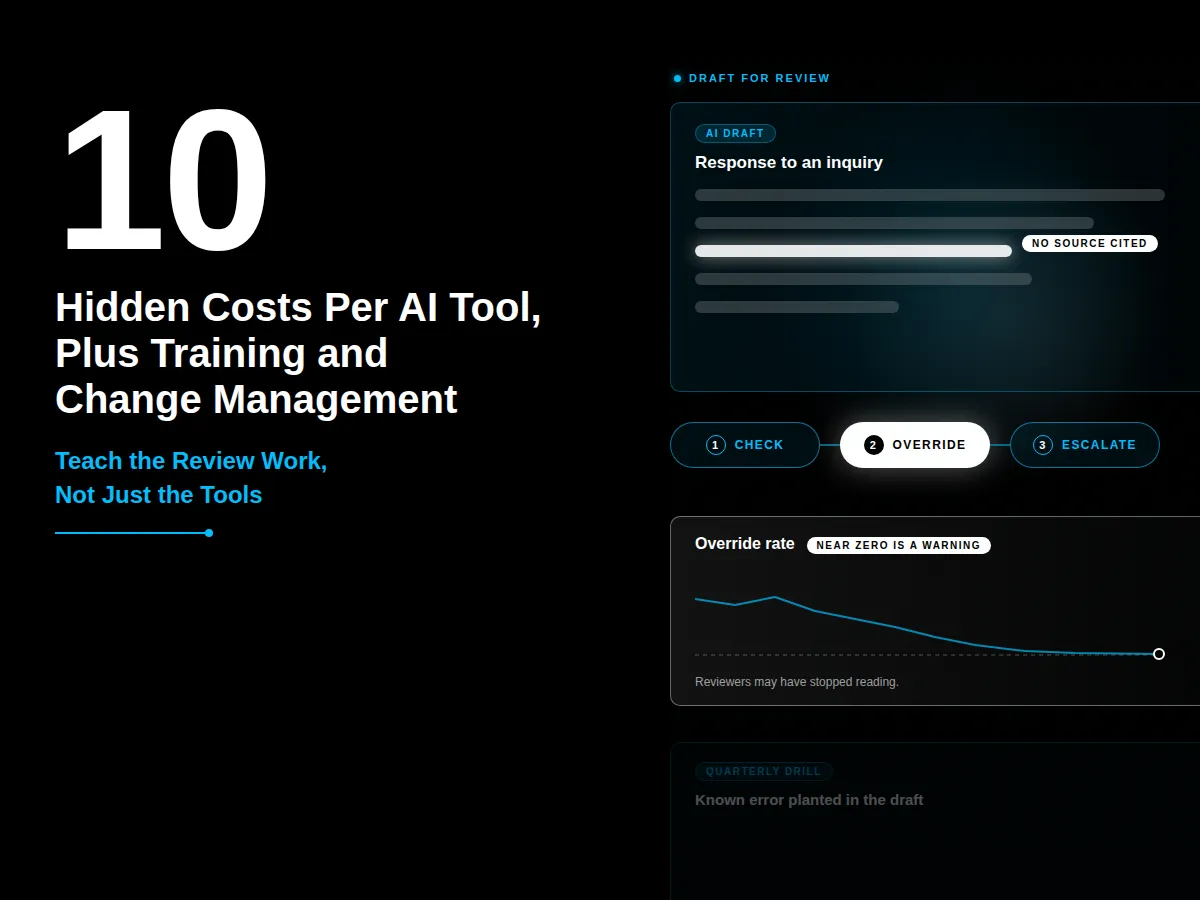
When to override. Write the rule down. For example, override any draft that cites no source.
How to escalate. Give reviewers a name and a channel. A reviewer who doesn't know whom to call will approve instead.
Which data rules apply. Cover what may go into an AI tool and what may not. Keep the list short enough to remember.
Tool skills still count. Our post on training your team to prompt the same way covers prompt playbooks, which are one small part of the program.
How should you deliver AI training for employees?
Teach with real work. Use drafts from your own workflow, including ones where the AI got it wrong. Have reviewers practice the override and the escalation, not just read about them.
Run the first sessions next to a live pilot. Our post on how to get your team to trust AI agents describes shadow mode. The agent runs beside people, and humans still make the call. It is a safe place to practice.
Keep AI upskilling sessions short and frequent, and refresh them when the model, the workflow, or the rules change. Forrester says upskilling and structured learning pathways strengthen readiness and build trust. (Forrester, April 2026)
Budget for the work. Gartner advises organizations to expect 10 hidden costs for every AI tool they buy, plus the transition costs of training and change management. (Gartner, November 2025)
How do you measure whether the training worked?
Track three things: the override rate, the escalation rate, and a weekly sample of review quality.
An override rate near zero is a warning, not a win. It can mean reviewers have stopped reading. A sudden jump can mean the AI changed, or the rules did.
Our guide to AI risk management for regulated enterprises covers the four production signals these numbers feed.
Test the skills, too. Gartner warns that if people rely too much on AI and stop using their core skills, skills atrophy can happen. It advises testing workers periodically. Run a short review exercise each quarter with a known error planted in the draft.
Where should a team start?
Start with one workflow and its reviewers. Write the override rule and the escalation path on one page. Then run one hands-on session using real drafts, including a bad one.
Your readiness assessment should already name the reviewer and the training need. If it does not, name them first.
If you'd like a second set of eyes on the plan, CI will work through it with your team. Talk to CI about AI training for your team.
Frequently asked questions
What is AI training for employees?
AI training for employees, sometimes called AI literacy training, teaches people how to use AI tools safely and well in their work. In a regulated team, it also teaches the review work: what to check, when to override the AI, and how to escalate.
What should AI training for employees include?
Include four lessons: what the AI can and can't do, when to override it, how to escalate, and which data rules apply. Add tool skills, such as prompting, as a smaller part of the program.
Who should get AI training first?
Train the reviewers first. Their approval is the control between the AI and the record. Then train managers, leaders, and everyone else who uses AI tools.
How often should you refresh AI training?
Refresh it whenever the model, the workflow, or the rules change. Also test reviewers each quarter, because skills can fade when people rely on AI.
Author

Craig Taylor

Share this article


Subject Matter Expert

Craig Taylor
Practice Lead, CI Digital
Speak With Our Team
Share this article