 Adobe
Adobe  Sitecore
  Gradial
  PEGA
PEGA How to Deploy Your First AI Agent Without Breaking Everything
Jul 15, 2026 | 7 min read
TL;DR
Only 17% of organizations have deployed an AI agent to date, but more than 60% plan to within two years. The gap between those numbers is execution, not appetite. Pick your most expensive repeatable process, treat the first build as a proof of architecture rather than a demo, and run a realistic 90-day plan. Skip the process mapping step and you join the more than 40% of projects Gartner expects to fail by 2027.
Two numbers tell the whole story of where most companies stand right now. Gartner's 2026 Hype Cycle for Agentic AI found that only 17% of organizations have actually deployed an agent to date. At the same time, more than 60% say they plan to within the next two years, the most aggressive adoption curve Gartner has measured for any emerging technology.
That gap between intent and execution is exactly where most readers of this series currently sit. You understand what an agent is. You've seen it work in production elsewhere. Your team knows what changes for them. The only question left is how to actually start without breaking something that currently works.
The one question to ask before touching any tooling
Before evaluating a single platform or vendor, answer this: what's your most expensive repeatable process right now? Not the use case that would look best in a board deck. Not the one your CTO saw in a flashy demo. The one that actually consumes the most labor hours or costs the most money every single week, measured in real terms.
That question matters because it forces a shift from “what's impressive” to “what's worth the risk.” Your first agent doesn't need to be ambitious. It needs to be worth building correctly, and it needs to be structured enough that success or failure is obvious quickly.
How to pick the right first workflow
The best candidates share a specific profile: high volume, structured decisions, and a process your team already understands well enough to document. Formulary monitoring, contract intake and review, claims and underwriting triage, and lead qualification are exactly the kind of workflows that fit. Each one involves a defined decision boundary a competent employee could describe if asked, even if nobody has written it down formally yet.
Avoid the opposite profile: a process with ambiguous judgment calls, no consistent decision logic, or one that only a handful of tenured employees fully understand. Those processes are exactly where an agent build stalls, because nobody can tell the agent what “correct” actually looks like.
The most common mistake: skipping the boring part
Gartner projects that more than 40% of agentic AI projects will fail or shut down by end of 2027, primarily due to unclear business value, poor data quality, or inadequate risk controls. Every one of those three causes traces back to the same root: teams skipped process mapping and data audit and went straight to building.
Process mapping means writing down the actual decision logic a person follows today, including the exceptions nobody talks about because they're assumed knowledge. Data audit means checking whether the records the agent will read are complete, consistent, and structured the same way across every source it touches. Both steps are unglamorous. Both are also the difference between an agent that works and one that quietly produces bad decisions at scale.
What “proof of architecture” means and why it beats a demo
A demo proves a model can do something once, under controlled conditions, with someone standing by to catch problems. It proves almost nothing about whether the system will hold up in production.
A proof of architecture is different. It proves the entire system works end to end on a real case, even a small one: the agent reads live data, makes a defensible decision, hands off correctly, and someone with real accountability signs off on the outcome. Escalation paths get tested. Data quality problems surface while the stakes are still low. Governance questions get answered before they become urgent.
That distinction is what actually de-risks scaling later. A team that ships a demo and calls it done has learned almost nothing. A team that ships a proof of architecture has learned exactly what needs to change before the second workflow, and the third.
The realistic 90-day plan
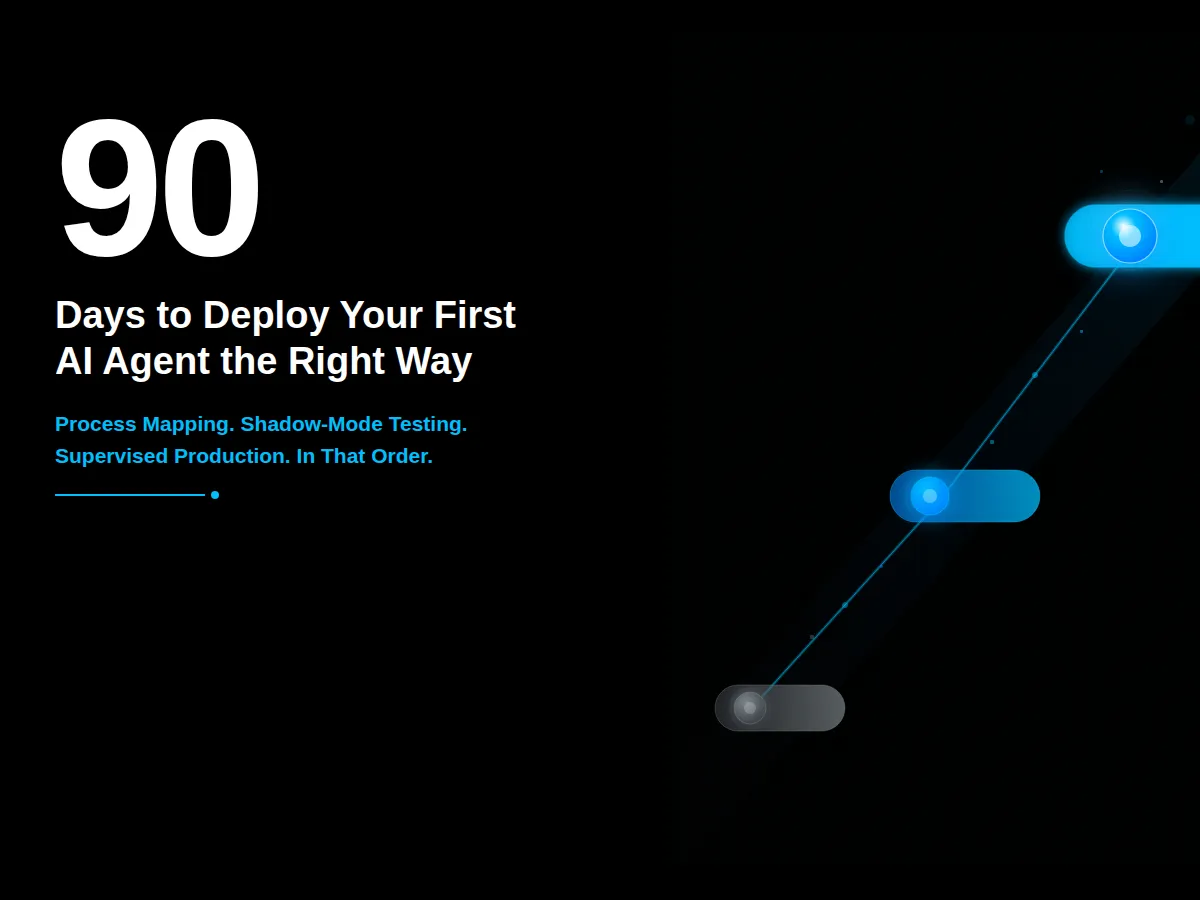
Weeks one through four cover process mapping and data audit. This is where the team documents the actual decision logic, including every exception, and checks the underlying data for completeness and consistency across every system the agent will touch. Rushing this phase is the single most common cause of downstream failure.
Weeks five through eight cover the agent build and shadow-mode testing. The agent runs alongside the existing manual process without making live decisions, and its outputs get compared against what a human actually decided. Discrepancies get investigated, not dismissed, because they usually reveal either a data problem or a decision rule nobody documented correctly.
Weeks nine through twelve move into supervised production. The agent starts making real decisions within its defined scope, with a human reviewing outputs closely at first and less frequently as confidence builds. This is also where the escalation criteria from the process mapping phase get tested against real, messy situations instead of hypothetical ones.
Teams that compress this timeline to save a few weeks almost always spend more time later untangling problems that the shadow-mode phase would have caught for free.
The real cost of waiting
The 60% of organizations planning to deploy within two years aren't wrong to wait for the right process. But waiting past having a clear first candidate has a real cost. Every month spent undecided is a month a competitor may be spending building the operational muscle this entire process teaches: how to map a workflow correctly, how to audit data honestly, and how to hand real accountability to a system without losing control of it.
None of that muscle transfers instantly. It's built one deployment at a time, and the companies that start now with a well-scoped first agent will be the ones with real experience by the time this becomes table stakes rather than a differentiator.
Before you start, make sure your team understands what changes for them and why. What Your Team Actually Needs to Work With AI Agents covers that groundwork. For examples of the kind of workflow that makes a strong first candidate, see AI Agents in Daily Business Operations. And once your first agent is live, governance becomes the next question. Operating in an Agentic World maps the rest of this series, including that topic.
Frequently asked questions about deploying your first AI agent
How do I choose the right first process for an AI agent?
Pick your most expensive repeatable process, not your most impressive one. The best candidates are high-volume, structured, and well enough understood that a competent employee could describe the decision logic if asked, even if it's never been formally documented.
What's the difference between a demo and a real deployment?
A demo proves a model can do something once under controlled conditions. A real deployment, or proof of architecture, proves the entire system works end to end on a real case: live data, a defensible decision, a correct handoff, and genuine human accountability for the outcome.
How long does a first AI agent deployment realistically take?
About 90 days for a well-scoped single workflow: four weeks for process mapping and data audit, four weeks for the agent build and shadow-mode testing, and four weeks for supervised production. Compressing this timeline usually costs more time later than it saves upfront.
What causes most AI agent deployments to fail?
Gartner attributes most failures to unclear business value, poor data quality, or inadequate risk controls, and all three typically trace back to skipping process mapping and data audit before building. Teams that document the actual decision logic and check their data first avoid the majority of common failure points.
Author

Craig Taylor

Share this article


Subject Matter Expert

Craig Taylor
Practice Lead, CI Digital
Speak With Our Team
Share this article