 Adobe
Adobe  Sitecore
  Gradial
  PEGA
PEGA What signal-aligned architecture means for pharma, and why your stack probably isn't built that way
Jul 31, 2026 | 8 min read
Every article in this series has circled the same problem from a different angle. HCP data shows up as five different records because nobody resolved identity at the architecture level. A CRM gets mistaken for a Provider 360 because it stores relationships but doesn't govern truth. Enrollment stalls in the handoffs because automation sped up tasks without coordinating the journey. Market access finds out about a formulary change a quarter too late because the data was built to report, not activate.
Those aren't four separate problems. They're the same architectural gap in four departments. This article ties that gap together under one name: signal-aligned architecture, and the three-step diagnostic CI Digital's Jeff Sumption uses before recommending any Salesforce configuration at all.
What does “signal-aligned” actually mean?
Signal-aligned means the architecture is designed around the business events that matter, not just the objects where data happens to be stored. For a pharma company, the signals that matter might include a provider affiliation change, a formulary update, a new access barrier, a patient enrollment delay, a prescribing behavior shift, a consent status change, a territory realignment, or a safety-related escalation.
A signal-aligned architecture makes those events visible, trustworthy, and actionable. It connects the data behind the event, applies rules for what should happen, routes the work to the right team, and measures whether the response actually changed the outcome. Most pharma data environments can tell you that a signal occurred, eventually, in a report. Very few are built to detect it and act on it while it still matters.
What's the difference between a system of record and a system of action?
A system of record answers “what happened.” It stores the provider's affiliation, the enrollment case, the formulary tier, the consent status. That's necessary. It's also not sufficient, because storing the fact that something changed isn't the same as doing something about it.
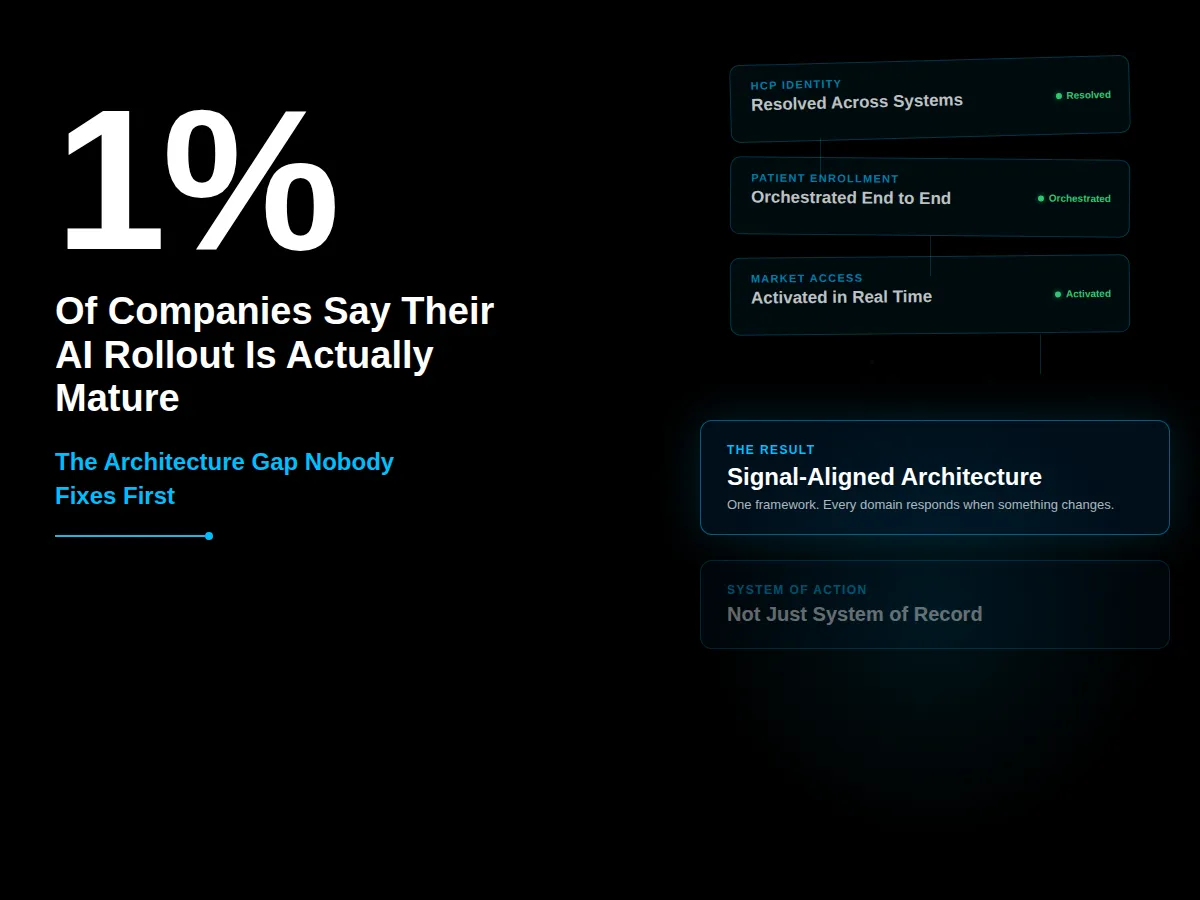
A system of action answers “what should happen now.” When a provider's affiliation changes, a system of action updates segmentation, notifies the field team, and adjusts the territory model without someone noticing the change three weeks later in a report. That's the shift this series has been describing, one functional domain at a time. Signal-aligned architecture is what makes that shift possible across all of them at once instead of one system at a time.
Even organizations investing heavily in the technology that could make this shift rarely get there. McKinsey found that while nearly every company now invests in AI, only 1% of C-suite respondents describe their AI rollouts as mature enough to be fundamentally changing how work gets done. (McKinsey, January 2025) The technology isn't the bottleneck. The architecture underneath it is, which is why this diagnostic starts before any product conversation.
What are the three things to look at before recommending any technology?
When CI Digital comes in to architect a Salesforce Life Sciences Cloud environment, the first three things we look at have nothing to do with Salesforce.
The first is the operating model. How does the business actually work right now? Who owns the patient journey, provider engagement, field activity, medical interaction, market access process, and compliance review? Technology recommendations that don't reflect how the organization actually operates fail at adoption, not at implementation. This is the first layer of the four-layer framework introduced in the series hub, and it's the layer most technology conversations skip.
The second is the data model. How are patients, providers, payers, plans, products, programs, cases, consents, and enrollments represented across the systems already in place? This is where HCP identity resolution lives, and where the gap between a CRM and a real Provider 360 becomes visible. Most data model problems surface once you map the relationships instead of assuming the CRM already captures them.
The third is integration and governance. Which systems are authoritative for which data? Where does data originate, and which systems need to consume it? What privacy, consent, audit, and compliance controls apply, and who owns each handoff? This is exactly the layer where patient enrollment stalls when handoffs aren't coordinated, and it's also where MuleSoft typically enters to connect the external systems Salesforce doesn't natively include.
Only after those three areas are understood does it make sense to talk about Salesforce configuration, Life Sciences Cloud capabilities, Data Cloud, MuleSoft, AI agents, or automation. Recommending technology before that diagnostic is finished is how organizations end up with expensive systems that store data well and still can't act on it.
How does this framework show up across the rest of pharma commercial operations?
The pattern is consistent whether you're looking at HCP data, patient enrollment, or market access. The gap always lives between analytics and operations. An organization can store data well, build clean reporting, and still struggle to act on what the data shows, because the insight was never connected to a workflow.
A market access dashboard can show that prescriptions dropped in a region after a formulary change, as covered earlier in this series, but if that insight doesn't create a task, update a segment, notify a case manager, or trigger outreach, the business is still dependent on someone noticing and acting manually. Organizations that close that gap have designed the path from signal to decision to workflow. They don't just ask whether they can report on something. They ask what should happen automatically when it changes.
What does a well-architected Salesforce pharma stack look like in practice?
In practice, the stack has clear layers that map directly to the diagnostic above. Salesforce Life Sciences Cloud or Health Cloud supports the core healthcare workflows: patient services, provider engagement, case management, enrollment, and program operations. Sales Cloud and Service Cloud capabilities support field and service workflows where they're needed. Data Cloud provides identity resolution, segmentation, calculated insights, and activation across systems. MuleSoft connects the external platforms: payers, hubs, specialty pharmacies, EHRs, document systems, and data providers. Tableau or CRM Analytics supports measurement. AI and agents assist with controlled, auditable tasks like intake, summarization, classification, routing, and recommendation support.
When that stack is designed well, the business moves from fragmented operations to coordinated execution. Signals get identified earlier. Work gets routed more intelligently. Manual reconciliation drops. Patient and provider experiences improve. And the organization ends up with a governed foundation that AI can actually be built on top of, instead of one more layer of automation sitting on top of the same fragmentation.
Where does a pharma organization actually start?
Start with the diagnostic, not the technology. Map the operating model for the one function causing the most visible pain, whether that's HCP engagement, enrollment, or market access. Map the data model underneath it. Identify the integration and governance gaps. Only then decide which Salesforce capabilities actually address what you found.
That order matters more than which product gets purchased first. A pharma organization that skips the diagnostic and buys the technology first usually ends up automating the fragmentation instead of fixing it.
CI Digital has walked through this diagnostic with pharma organizations working through HCP data, patient enrollment, and market access challenges, and built the signal-aligned architecture underneath each one. Talk to our Salesforce team about where your architecture actually stands today.
Frequently asked questions
What does signal-aligned architecture mean in a pharma Salesforce environment?
Signal-aligned architecture means the system is designed around the business events that matter, such as a provider affiliation change or a formulary update, rather than just the objects where data is stored. It connects the data behind each event, applies rules for what should happen next, routes the work automatically, and measures whether the response changed the outcome.
What is the difference between a system of record and a system of action?
A system of record stores what happened: a provider's affiliation, an enrollment case, a formulary tier. A system of action determines what should happen next and triggers it automatically, such as updating segmentation or alerting a field team the moment a signal is detected.
What are the first three things CI Digital evaluates before recommending Salesforce Life Sciences Cloud capabilities?
The operating model, which is how the business actually works and who owns each function. The data model, which is how patients, providers, payers, and other entities are represented across existing systems. And integration and governance, which covers which systems are authoritative, where data originates, and what compliance controls apply.
Why do pharma organizations struggle to act on data even when their reporting is strong?
Because the gap between analytics and operations usually isn't a reporting problem. It's a workflow problem. A dashboard can show that something changed, but if that insight doesn't automatically create a task, update a segment, or trigger outreach, the organization is still dependent on someone noticing and acting manually.
Author

Jeff Sumption

Share this article


Subject Matter Expert
Jeff Sumption
Salesforce Solution Architect
Speak With Our Team
Share this article