 Adobe
Adobe  Sitecore
  Gradial
  PEGA
PEGA AI Agent Governance: Who's Accountable When Something Goes Wrong?
Jul 30, 2026 | 6 min read
TL;DR
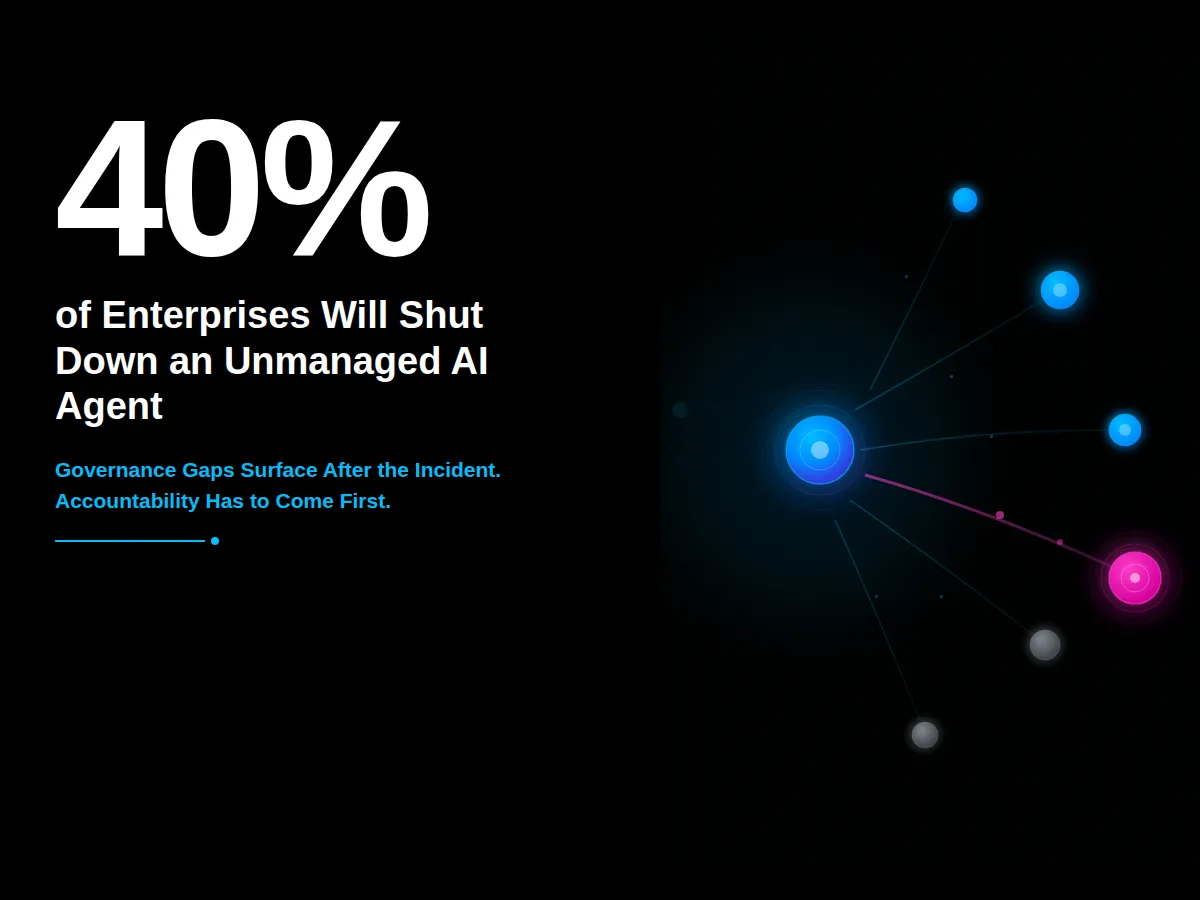
Gartner projects that by 2027, 40% of enterprises will demote or decommission an autonomous AI agent because governance gaps only surfaced after a production incident. The root cause: treating every agent with the same governance, regardless of what it's actually allowed to do. Real accountability means a named person, not a team, responsible for each agent's decisions, and monitoring infrastructure built in from the start, not added after something breaks.
Every executive signing off on an AI agent asks some version of “does it work?” Far fewer ask the harder question first: who owns it when it doesn't?
That question isn't paranoia. Gartner's research, published in May 2026, found that by 2027, 40% of enterprises will demote or decommission an autonomous AI agent specifically because governance gaps only became visible after a production incident. The agent didn't fail because the technology was bad. It failed because nobody had defined who was responsible before it started acting.
Why treating every agent the same is the root cause of failure
Gartner's core finding is blunt: enterprises applying the same governance framework across every agent, regardless of autonomy level or scope, are heading toward failure. Shiva Varma, Senior Director Analyst at Gartner, put it directly: enterprises treat AI agent governance as binary, either locked down or fully trusted, and that's the root cause.
The problem is that agents don't all do the same kind of work. Some summarize documents. Others send emails, modify production databases, or approve transactions. An agent that reads and reports needs a different level of oversight than one that writes to a system that matters. The critical distinction Gartner draws is between an agent's ability to act and the scope of access someone actually gave it. Confusing the two, or ignoring the difference entirely, is where governance breaks down. A summarization agent with read-only access to a shared drive carries a fundamentally different risk profile than an agent that can initiate a wire transfer, even if both run on the same underlying model.
What “human in the loop” actually means in practice
The phrase gets used constantly and means almost nothing on its own. McKinsey's 2026 AI Trust Maturity Survey, covering roughly 500 organizations, found something more concrete: organizations with explicit, named accountability, meaning a specific person, not a team or department, responsible for each agent's decisions, score measurably higher on governance maturity than organizations with diffuse ownership.
That's the real version of human in the loop. Not a policy statement that says a human is involved somewhere. A named person whose job includes owning what that agent does. When something goes wrong, there's no ambiguity about who investigates it, who explains it, and who has the authority to shut it down.
This directly extends the theme from earlier in this series: agents change roles rather than eliminate them, and one of the roles that changes is exactly this one. Someone on the team becomes the accountable owner for the agent's decisions, and that responsibility needs to be explicit, not assumed.
The governance layer: monitoring agents at scale
Two-thirds of organizations in McKinsey's survey cite security and risk as their primary barrier to scaling agentic AI, ahead of regulatory uncertainty. That's a meaningful signal. Companies aren't stuck because the technology doesn't work. They're stuck because they don't have confidence in their ability to see what their agents are actually doing.
Real governance infrastructure looks like continuous monitoring of agent activity, enforced guardrails that limit what an agent can access or do, rollback mechanisms that undo an action if something goes wrong, and circuit breakers that halt an agent automatically when it crosses a defined threshold. This isn't a policy document sitting in a shared drive. It's built into the system the same way security gets built into a deployment pipeline, checked continuously rather than reviewed once a quarter.
Why governance needs to be designed in, not bolted on
This connects directly to the deployment process covered earlier in this series. The process mapping and data audit phase of a 90-day rollout is exactly where escalation criteria and accountability get defined, before the agent ever touches production. That's not a coincidence. Governance designed during that phase is cheap. Governance retrofitted after an incident is where Gartner's 40% failure stat comes from.
Teams that build the accountable-owner structure, the monitoring, and the escalation paths into the initial rollout rarely face the binary choice Gartner warns about, lock it down completely or trust it blindly, because they've already defined the middle ground for each specific agent based on what it's actually allowed to do.
How CI approaches this with clients
This is where CI's partnership with Classie AI becomes directly relevant. Classie's supervision platform deploys inside a client's environment without requiring invasive architecture changes or developer instrumentation, and gives full visibility into how AI agents interact with users, data, and tools in real time. That visibility is the foundation everything else in this article depends on: you can't hold an agent accountable for what you can't see.
From there, CI helps clients build live agent inventories, enforce governance policies matched to each agent's actual scope rather than a one-size-fits-all standard, and maintain human-understandable audit trails aligned to what CIO, CISO, legal, and risk teams each need. The goal isn't to slow deployment down. It's to make speed defensible, so that when an executive asks who's accountable, there's a real answer, backed by a named owner and a record of exactly what the agent did and why.
This closes out the full series. If your team is working through the people side of an agent rollout, What Your Team Actually Needs to Work With AI Agents covers that groundwork. If you're still in the deployment planning stage, How to Deploy Your First AI Agent Without Breaking Everything is where governance should get built in from day one. And for the full map of everything covered in this series, start with Operating in an Agentic World.
Frequently asked questions about AI agent governance
Who is legally or organizationally accountable when an AI agent makes a mistake?
Accountability should rest with a specific named person, not a team or department, who owns that agent's decisions. Organizations with this explicit structure score measurably higher on governance maturity than those with diffuse ownership, according to McKinsey's 2026 research.
Do all AI agents need the same level of governance?
No. Gartner's research specifically warns against uniform governance across all agents. Governance should match the agent's actual scope of access and ability to act.
What does real AI agent monitoring actually involve?
Continuous visibility into agent activity, enforced guardrails, rollback mechanisms, and circuit breakers that halt an agent automatically when it crosses a defined threshold.
When should governance planning happen in an AI agent deployment?
During the process mapping and data audit phase, before the agent touches production. Defining escalation criteria and accountability upfront is cheaper than retrofitting governance after an incident.
Author

Craig Taylor

Share this article


Subject Matter Expert

Craig Taylor
Practice Lead, CI Digital
Speak With Our Team
Share this article